
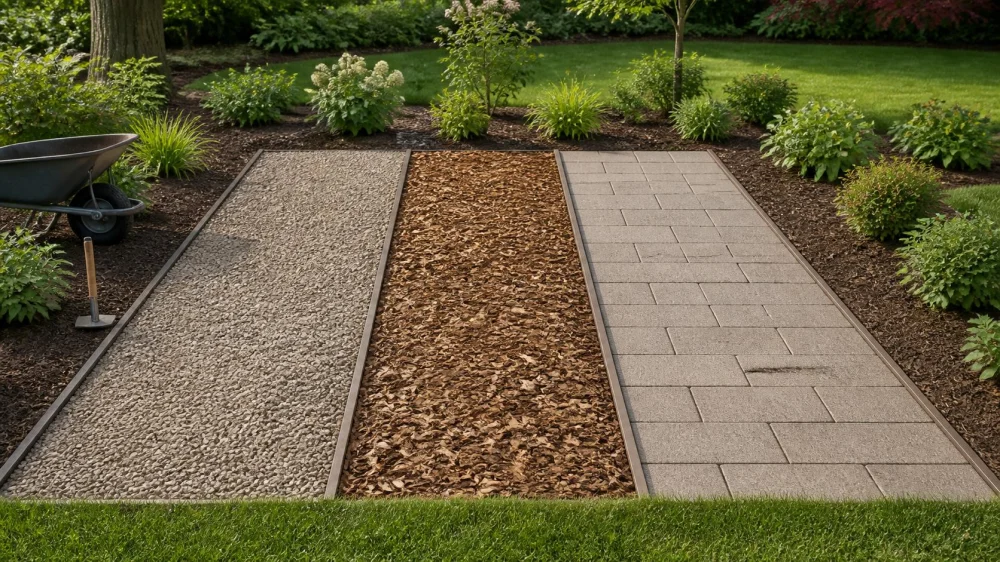
Garden Path Surface Guide: Gravel, Mulch, or Pavers?
On this page
- Quick answer
- Define the path's job first
- When to choose compacted gravel
- When to choose wood mulch
- When to choose pavers
- Plan for wheels, feet, and maintenance carts
- Design drainage and grade
- Account for fire, frost, heat, and snow
- Compare installation scopes
- Compare ongoing maintenance
- Path decision checklist
- Frequently asked questions
- Sources and evidence notes
- Conclusion and next steps
Quick answer
Choose compacted gravel for a permeable, repairable path when the base and edging can keep it firm; wood mulch for a low-cost informal garden route that can be replenished; and pavers for a durable, defined surface when proper excavation and base preparation fit the budget. Before buying, compare users and wheeled equipment, slope, drainage, freeze-thaw conditions, wildfire guidance, snow removal, weeds, edging, utilities, and maintenance. Build a small test section and get an itemized installation scope.
This US guide compares broad material categories. Product sizes, base designs, accessibility requirements, permits, drainage rules, wildfire guidance, and installation details depend on the site and jurisdiction.
Define the path's job first
A garden path surface should match how often the route is used, who uses it, what equipment travels on it, and how water moves across the site. Appearance comes after those functional decisions.
List the route's users: walking adults, children, older visitors, wheelchair or scooter users, people using canes or walkers, wheelbarrows, mowers, trash carts, strollers, or service equipment. Note the heaviest expected load and the wettest season.
Distinguish a lightly used stepping route through planting from the primary connection between a door, driveway, patio, gate, and shed. Primary paths usually justify a firmer, more stable surface and stronger edge control.
When to choose compacted gravel
Compacted crushed aggregate can form a permeable-looking, relatively firm path when particle size, fines, depth, base, moisture, compaction, edging, and drainage work together. Loose rounded pea gravel behaves differently and can shift under feet and narrow wheels.
Choose gravel when you want a material that can be regraded, topped up, or opened for a repair more easily than a monolithic surface. It can suit informal and formal designs depending on color and edge treatment.
Gravel is not ideal when the proposed material remains deep and loose, the path crosses a steep slope, sediment washes onto it, snow equipment will scatter it, or users require a consistently firm and stable route that the design cannot provide.
When to choose wood mulch
Wood chips or bark can create a soft, informal path between beds and reduce mud and soil compaction. It is often economical for low-traffic garden areas and easy to relocate as beds change.
Choose mulch when periodic replenishment is acceptable and the route does not need to support small hard wheels. Coarse chips may interlock better than light shredded material on some sites, but local availability and performance vary.
Mulch is not ideal beside a building where local wildfire guidance calls for a noncombustible zone, on a route that floods or washes material downhill, or where a wheelchair, walker, cart, or narrow stroller wheel needs a smooth firm surface.
When to choose pavers
Concrete, clay, or stone pavers can create a defined durable path. When units are even, joints are controlled, and the base is stable, the surface can support frequent foot traffic and wheeled equipment.
Choose pavers when a long service life, crisp geometry, firm surface, and easier sweeping or snow clearing justify the higher installation effort. Permeable paver systems may manage water through designed joints and subsurface layers, but they are engineered assemblies rather than ordinary pavers with wider gaps.
Pavers are not ideal when inadequate excavation, poor base compaction, uncontrolled roots, drainage failure, or freeze-thaw movement will create settlement and trip edges. Heavy or irregular natural stone also requires skilled layout and handling.
Plan for wheels, feet, and maintenance carts
A route intended for mobility devices should be firm, stable, slip-aware, wide enough for the expected user, and free of abrupt level changes and obstructions. Smooth, maintained hard surfaces are typically easier to navigate; properly designed compacted gravel may work in some garden settings.
Width must account for turns, passing or resting points, door swings, handrails, plants at mature size, and wheelbarrow handles. Do not let edging project into the path or create a sharp trip edge.
Build a representative test section with the actual surface, slope, joints, and edge. Have intended users try it in dry and wet conditions before committing to the full path. Public or required accessible routes need review under applicable standards, not only a homeowner trial.
Design drainage and grade
Observe runoff before construction. Identify roof discharge, irrigation overspray, low points, compacted subsoil, erosion, and water flowing from neighboring or uphill land. A surface is not “permeable” if the base clogs or the underlying soil cannot accept water.
Grade should move water safely without sending it toward a foundation, doorway, neighboring property, septic area, unstable slope, or eroding bed. Cross-slope and longitudinal slope also affect walking comfort and accessibility.
Permeable pavers and porous aggregate paths need carefully prepared subsurface layers and maintenance to keep voids open. Ask who designs overflow for storms larger than the system can infiltrate.
Account for fire, frost, heat, and snow
In wildfire-prone areas, local guidance may favor noncombustible gravel, rock, concrete, or pavers close to structures and discourage combustible wood mulch. The required zone and materials depend on local rules and risk.
Freeze-thaw climates require suitable base depth, drainage, edge restraint, and installation timing. Frost movement can heave pavers and create depressions in poorly drained gravel.
Dark stone can become hot in sun. Organic mulch can dry, decompose, move, and freeze into uneven patches. Snow shovels and plows interact differently with joints, loose stone, and chips. Test the removal method before winter.
Compare installation scopes
Every quote should show path length, finished width, excavation depth, disposal, subgrade preparation, geotextile if specified, base type and compacted depth, surface product and depth, edging, drainage, utility protection, transitions, cleanup, and restoration.
Ask whether depths are loose or compacted measurements and how compaction will be verified. Request a sample of the actual gravel, mulch, or paver rather than choosing from a generic color name.
Confirm underground utility locating before excavation and check permits, homeowner-association rules, drainage restrictions, property boundaries, and tree-root protection. A path should not cut major roots or bury a root flare without professional evaluation.
Compare ongoing maintenance
| Surface | Typical recurring work | Common failure sign |
|---|---|---|
| Compacted gravel | Rake, top up, compact, clear sediment, repair edging | Ruts, loose pockets, washout, migrated stone |
| Wood mulch | Replenish, redistribute, remove weeds and debris | Thin bare soil, washed piles, decomposition |
| Pavers | Clean joints, reset settled units, manage weeds, inspect edges | Rocking units, trip lips, open joints, ponding |
No surface is maintenance-free. Budget labor, replacement material, weed management, snow clearing, and repairs over several years, not only the installation price.
Path decision checklist
- Map the route, doors, gates, turns, slopes, utilities, roots, and drainage.
- List walkers, mobility devices, strollers, carts, mowers, and service loads.
- Choose a target for firmness, stability, width, joints, and edge height.
- Compare compacted angular gravel with loose rounded gravel explicitly.
- Check wildfire, freeze-thaw, heat, rainfall, and snow-removal conditions.
- Review base, drainage, edging, transitions, and overflow—not only surface color.
- Build and use a test section in realistic wet and dry conditions.
- Compare itemized installation and multi-year maintenance costs.
- Confirm utilities, permits, property rules, and tree-root protection.
Frequently asked questions
Is gravel accessible for a wheelchair?
Some properly designed and maintained compacted gravel surfaces can be usable, while deep loose gravel is difficult for many wheels. Evaluate the actual material, compaction, slope, edges, and applicable standards.
Is mulch the cheapest path?
It often has a low initial material cost, but delivery, edging, replenishment, washout, weeds, and labor affect the long-term cost.
Do permeable pavers eliminate runoff?
No. Performance depends on design rainfall, subsurface storage, soil infiltration, underdrains, overflow, installation, and maintenance. Larger storms still need a safe overflow route.
Can pavers go directly on soil?
A durable path usually needs project-specific excavation and base preparation. Direct placement may rock, settle, spread, or become uneven depending on soil, loads, moisture, and frost.
Sources and evidence notes
Oregon State University Extension recommends smooth, level, clutter-free garden routes for people using mobility devices and notes that maintained hard surfaces and suitably compacted gravel can support access. See Gardens Are for Everyone.
Penn State Extension explains that porous and permeable paving depends on a carefully prepared subsurface, while Oregon State wildfire guidance favors noncombustible hardscape near homes in fire-prone settings. See Penn State's permeable paving overview and OSU fire-resistant landscape guidance.
Conclusion and next steps
Pick a garden path from the route's work outward. Compacted gravel is repairable and informal-to-refined, mulch is flexible and renewable, and pavers offer a firm defined surface when the base is built correctly. Compare users, water, climate, edges, installation, and maintenance, then test the real assembly. The best-looking material is only a good choice when it remains safe and functional on the actual site.

 Plant Land Garden Center & Lakeside Brewing Supplies4.0 (65 reviews)
 Gibson Lawn Service4.0 (22 reviews)
 GreenWorks Lawn Solutions, LLC.4.0 (43 reviews)
 Fox Den Landscape & Nursery4.0 (19 reviews)
 Keeling's Landscape Inc.3.0 (13 reviews)
 All American Turf Beauty, Inc.4.0 (9 reviews)
 Downspout Extension Guide: Route Roof Water Safely
 How to Install Low-Voltage Lighting in Your Garden: A Step-by-Step Guide
 The Rise of Tapestry Lawns: Living Ground Cover Alternatives for Modern Yards
 Newly Planted Tree and Shrub Watering Log: Adjust as Roots Establish
 How to Deal With Poor Soil: Amendments & Improvements for Better Gardening
 How to Care for a Newly Planted Landscape for Healthy Growth