
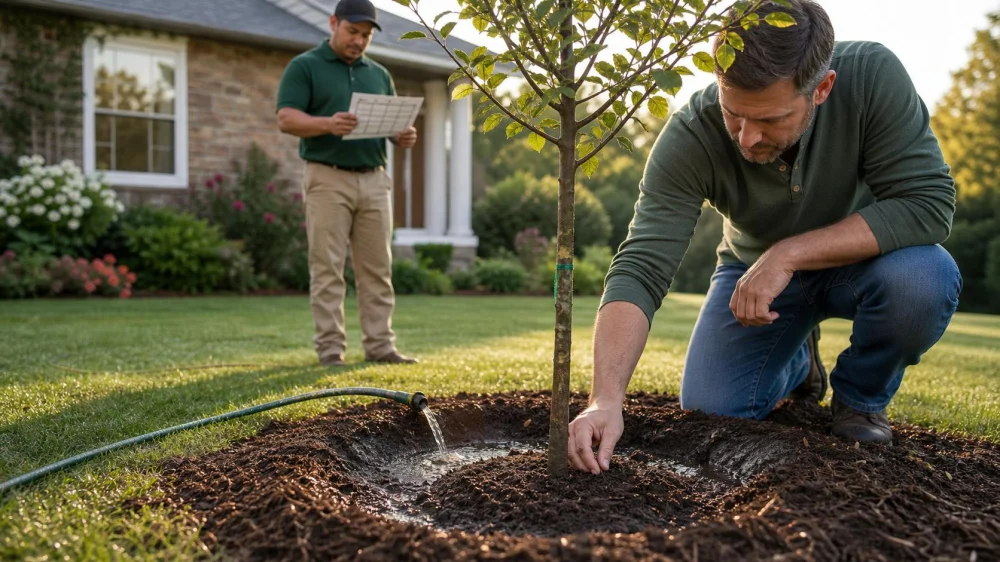
Newly Planted Tree and Shrub Watering Log: Adjust as Roots Establish
On this page
- Quick answer
- Start with a site-specific care plan
- Record the plant and root-ball size
- Check moisture before watering
- Water the root ball and surrounding soil
- Choose a slow, measurable delivery method
- Adjust for rain, heat, and soil
- Manage mulch and plant competition
- Read stress signs cautiously
- Keep the log and schedule follow-up
Quick answer
Newly planted trees and shrubs need consistent moisture in the original root ball and adjacent backfill while new roots expand. Do not water only by the calendar. Before each planned irrigation, check moisture below the surface, review meaningful rainfall, and look for drainage problems. Then apply a measured amount slowly enough to soak the root zone without running off or leaving the plant in standing water.
Keep a simple log with date, rain, soil feel, water amount, delivery time, plant response, and any maintenance. The expected frequency usually decreases as roots establish, but season, species, stock size, soil, slope, exposure, drainage, and local restrictions change the plan. Follow the installer’s written warranty requirements and local extension guidance for your region.

Start with a site-specific care plan
At installation, ask the landscaper to identify the root flare, root-ball width, backfill area, irrigation zone, mulch boundary, staking plan, and expected establishment period. Get the species and cultivar, planting date, nursery stock size, warranty, and maintenance responsibilities in writing. Photograph the finished planting from several angles.
Confirm who waters when the homeowner, landscape company, property manager, and irrigation contractor share duties. A warranty may require documentation, but a generic schedule may not match an unusually rainy week or poorly drained soil. Name one person responsible for checking moisture and recording the decision.

Gunnar Olsen Landscaping
Williams BayWalworth CountyWisconsin
523 Woodlawn Dr, Williams Bay, WI 53191, USA
Record the plant and root-ball size
Water quantity is easier to plan when you know the dimensions used by local guidance. For a tree, record trunk caliper using the nursery or installer’s measurement. For a container shrub, record container volume. For balled-and-burlapped or bare-root material, ask the installer what measurement controls the aftercare recommendation.
The University of Minnesota Extension’s guide to watering newly planted trees and shrubs provides examples based on tree caliper and shrub container volume, along with changing intervals during establishment. Those Minnesota examples illustrate a measured approach; adapt quantities and timing to the plant, local climate, soil, and professional instructions rather than applying one regional schedule everywhere.
Check moisture before watering
Move mulch aside at a few points and check soil near the root ball and in the surrounding backfill at the depth recommended by your local extension service. The surface can be dry while deeper soil remains wet, or a dense nursery root ball can be dry while surrounding soil is moist. Use clean fingers, a suitable soil probe, or a moisture tool whose readings you have learned to interpret in that soil.
Soil that feels dry or only slightly damp at the check depth may need water; soil that is sticky, saturated, or releases water when squeezed needs time and a drainage check. Replace mulch without piling it against the trunk or stems. Avoid probing into utility zones, irrigation tubing, or a tightly wrapped root ball.
Water the root ball and surrounding soil
During early establishment, direct water over the root ball and the backfill immediately around it. As roots spread, gradually widen the wetted area. Watering only at the trunk leaves much of the root ball dry, while watering only the outer bed may miss the original nursery soil. A low soil berm at the root-zone edge can help hold water when professionally installed without burying the root flare.
Do not create a permanent basin that stays flooded or channels runoff toward a building. Keep the root flare visible and check that the plant has not settled too deeply. If water consistently runs away, ponds for long periods, or exposes roots, have the installer assess grade, soil interface, and planting depth.
Choose a slow, measurable delivery method
A hose at a slow trickle, drip emitters placed correctly, a watering bag used according to its instructions, or a dedicated low-flow zone can deliver water gradually. Calibrate the method: time how long it takes to fill a known container at the same setting, then estimate the runtime needed for the planned volume. Recheck because pressure and emitter performance change.
Inspect bags and drip systems each time for clogs, tears, displacement, trunk rubbing, and uneven output. Remove or reposition equipment as required by the manufacturer and plant growth. Lawn spray may wet leaves and surrounding turf without delivering enough to a dense root ball, so do not assume an irrigation cycle equals a complete establishment watering.
Adjust for rain, heat, and soil
Record rainfall from a nearby gauge rather than assuming a brief shower reached the roots. Check moisture after rain before deciding to skip or add irrigation. Sandy or fast-draining soil may dry sooner, while clay or compacted soil can remain saturated. Wind, reflected heat, sun exposure, and an unusually warm period can increase water loss.
Do not compensate for hot weather by watering saturated soil. Conversely, do not withhold water solely because the top looks dark. During drought restrictions, follow local rules and ask whether establishment watering has a specific exemption or permit. After heavy rain, inspect for ponding, erosion, leaning, exposed roots, and mulch movement.
Manage mulch and plant competition
A broad layer of organic mulch can moderate soil temperature, reduce evaporation, and limit weeds. Maintain the depth recommended for the material and site, keeping mulch away from the trunk, root flare, and shrub stems. Remove buried landscape fabric or edging conflicts only as the installer or arborist recommends.
Turf and weeds compete with establishing woody roots for moisture. Keep the intended mulched root zone free of aggressive growth without damaging shallow roots with a string trimmer or herbicide. Do not add fertilizer automatically; a soil test, plant need, and regional guidance should determine whether and when nutrients are appropriate.
Read stress signs cautiously
Wilting, curled or scorched leaf edges, premature fall color, leaf drop, slow shoot growth, or dieback can occur with inadequate water—but similar symptoms can result from saturated roots, planting depth, root damage, transplant stress, disease, pests, salt, or herbicide exposure. Check soil and the whole site before responding with more irrigation.
Call the installer, certified arborist, or qualified landscape professional for a leaning tree, loose root ball, damaged trunk, broken staking, persistent ponding, foul soil odor, extensive dieback, or no improvement after the care plan is corrected. Do not prune heavily, dig up the root ball, or add repeated treatments without diagnosis.
Keep the log and schedule follow-up
For each plant or group, record the date, rainfall, weather, soil condition at the check depth, water volume, delivery method and runtime, runoff or ponding, leaf condition, and person who performed the check. Add photos from the same viewpoint every few weeks. The record shows trends and supports a warranty conversation better than memory alone.
Review the plan as seasons change and extend the watering area as roots grow. Arrange installer or arborist follow-up before the warranty inspection, after severe weather, and whenever the plant’s response does not match the site conditions. Gradually transition from establishment watering to long-term, weather-responsive care instead of ending on an arbitrary date.





 Dirty Deeds Lawn & Landscaping, LLC4.0 (65 reviews)
 Walmart Patio & Garden Services0.0 (0 reviews)
 Steppers Cuts5.0 (1 reviews)
 frommann landscape3.0 (4 reviews)
 Alwerdt's Gardens LLC4.0 (56 reviews)
 Arrow Valley Landscaping5.0 (69 reviews)
 How to Plant for Privacy Along Property Lines
 How to Use Container Gardens to Frame Doorways for Stunning Curb Appeal
 How to Grow a Native Plant Garden That Requires Little Care
 How to Install a Drip Irrigation System in Your Landscape
 How to Use Moss and Groundcovers for a Woodland Feel
 How to Incorporate Seasonal Lighting Into Your Landscape Design