
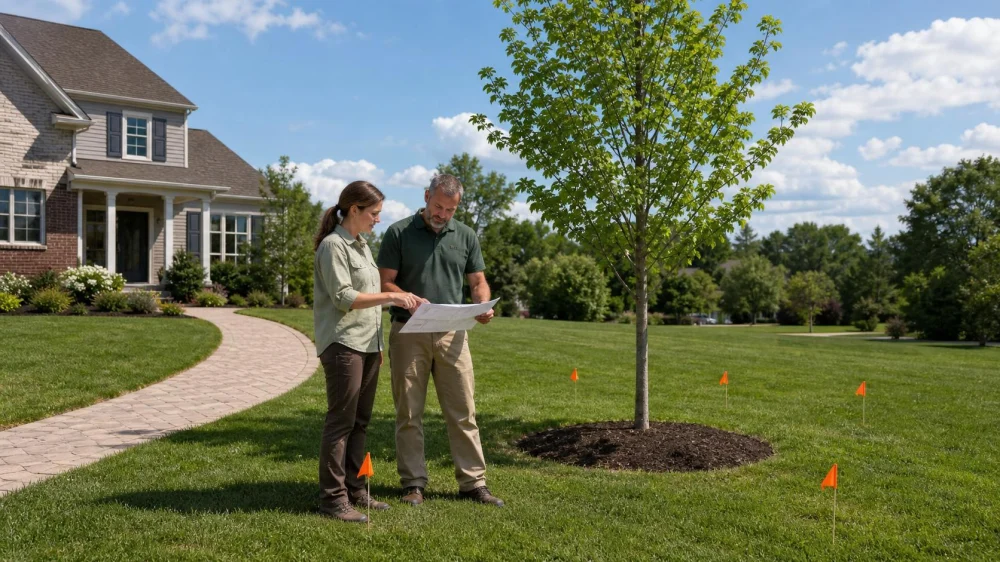
Shade Tree Placement: Plan Canopy, Roots, and Utilities
On this page
Quick answer
Choose a tree for its mature size and site conditions, not its nursery size alone. Map buildings, pavement, overhead lines, underground utilities, drainage, sun, and usable root space before locating the planting area. Confirm local restrictions and utility marking before digging, then review installation, watering, protection, pruning, and inspection responsibilities with the landscaper or arborist.
Why a small nursery tree needs a full-size site plan
A young tree may fit almost anywhere on installation day, while its mature canopy, trunk flare, roots, shade, litter, and water demand interact with the whole property for decades. Placement affects cooling and views, but also clearance from roofs and wires, pavement movement, drainage, sight lines, lawn performance, access, and the tree's ability to establish without repeated hard pruning.
This guide is for United States homeowners planning one landscape shade tree with a contractor, nursery, or qualified arborist. It is not a species prescription, engineering plan, utility clearance, legal boundary opinion, or planting specification. Climate, soil, easements, wildfire exposure, pests, and local rules vary widely.
Practical checklist
- Local planting, right-of-way, visibility, street-tree, homeowner-association, easement, protected-tree, and wildfire requirements.
- Marked underground utilities, private irrigation and lighting lines, septic components, drainage pipes, wells, and planned future work.
- Overhead electric and communication lines, roof edges, solar panels, chimneys, streetlights, signs, and expected mature canopy clearance.
- House foundation, retaining walls, fences, pavement, pools, play areas, driveways, gates, emergency access, and neighbour boundaries.
- Regional suitability, mature height and spread, growth form, roots, fruit or litter, thorns, toxicity, pest concerns, and maintenance demand.
- Sun, heat reflection, wind, soil texture and compaction, drainage, slope, irrigation coverage, available root volume, and existing vegetation.
- Plant size, root condition, delivery route, equipment access, planting season, watering ownership, warranty terms, staking, mulch, and follow-up.
Step-by-step plan
- Define the shade, screening, habitat, or spatial goal and mark several candidate locations rather than selecting one point immediately.
- Obtain current utility marking before excavation and separately identify private lines and site systems not included in the public marking service.
- Draw the mature canopy and usable root area at each location, then check clearances from structures, paving, wires, drainage, access, and sight lines.
- Ask a regionally knowledgeable arborist or landscape professional to match species and cultivar characteristics to the actual soil, climate, water, and space.
- Confirm plant quality, root flare, planting depth, hole and backfill method, mulch placement, staking criteria, protection, and the initial watering plan in writing.
- Photograph the marked site and installed tree, save the plant label and warranty, and record who will water, inspect, adjust ties, and authorize pruning.
- Recheck soil moisture, stability, damage, and growth through establishment; revise care for weather and site observations rather than relying only on a calendar.
Keep the plan showing the selected location, utility ticket and marks, private-line checks, species and cultivar, mature dimensions, nursery tag, installation date, photos, root-flare position, mulch and staking details, watering log, warranty, inspections, pruning, damage, and contractor or arborist recommendations.
Limits and important notes
Do not excavate before required utility marking, plant directly over known services, assume roots stay inside the canopy line, top a tree to force it into a small space, or rely on a generic distance for every species and soil. Do not work near energized lines; utility vegetation work requires authorized specialists.
Stop work for unmarked utilities, unexpected pipes or cables, unstable excavation, contaminated soil, boundary disputes, or conflicts with overhead power. Contact the relevant utility owner for line clearance, a qualified arborist for species and structure, and an engineer or drainage professional when planting could affect a wall, slope, foundation, or water route.
Frequently asked questions
How far should a shade tree be from the house?
There is no universal distance. Base placement on mature form, species, soil, foundation and roof conditions, access, local rules, and professional site review.
Can I plant under a power line if the tree is small now?
Only use utility-compatible guidance and an appropriate mature size. Do not plan on repeated topping or work within electrical clearance zones.
Will roots always damage pavement?
Risk depends on species, soil, space, pavement design, moisture, and distance. Provide suitable root volume and obtain site-specific advice.
Should a new tree always be staked?
No. Stake only when site and root-ball stability require it, use a suitable flexible system, inspect it, and remove it on the recommended schedule.
When should watering stop?
Establishment time varies. Monitor soil moisture, weather, root development, and professional guidance rather than ending on one fixed date.
Sources and evidence
Use current municipal tree and right-of-way rules, the local utility marking service and utility-owner guidance, regional extension or forestry resources, nursery documentation, and site-specific advice from a qualified arborist. Electrical, easement, wildfire, and protected-tree requirements override a generic landscape concept.
Conclusion and next steps
Mark candidate planting areas without digging, map mature canopy and root space, request required utility location, and compare each option against structures, access, drainage, wires, and long-term care. Then confirm the species, installation details, watering responsibility, warranty, and inspection schedule in writing.
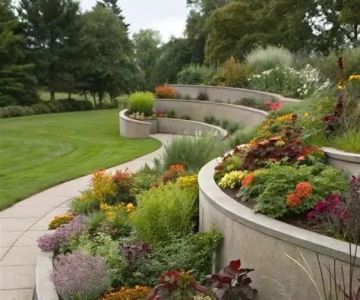
 Nature's Green Nursery Inc4.0 (13 reviews)
 Heyden's Gardens4.0 (70 reviews)
 ProscapeS Unlimited, LLC4.0 (7 reviews)
 Walmart Patio & Garden Services0.0 (0 reviews)
 Affordable Lawn & Landscaping LLC5.0 (4 reviews)
 AVL Landscaping Inc.4.0 (30 reviews)
 How to Choose Outdoor Seating That Complements Your Garden
 How to Integrate a Garden Pond Into a Modern Landscape
 How to Incorporate Hardscape Accents Into a Softscape Plan for Balanced Landscapes
 How to Build a Dry Creek Bed for Drainage & Visual Appeal
 Lazy Lawn Care: How to Maintain Grass with Minimal Effort
 How to Build a Stone Pathway With a Natural Flow