
Landscape Fabric Under Mulch: Questions Before Installation
Table of contents
Quick answer
Do not specify landscape fabric until you know the bed's purpose, mulch type, plants, irrigation, soil, drainage, and expected lifespan. Fabric may separate stone from soil and suppress some weeds, but it does not end maintenance. Organic mulch changes as it decomposes, weeds can root above fabric, and plant additions become harder. Ask the landscaper how water passes, edges are secured, and removal will work.

Niemeyer's Landscape Supply
810 N Indiana Ave, Crown Point, IN 46307, USA
Define the goal
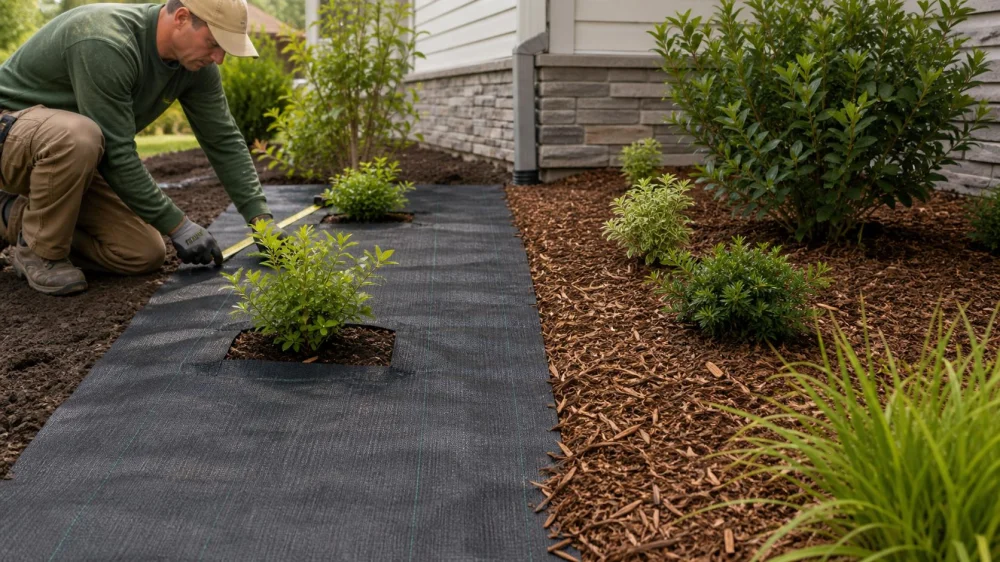
Landscape fabric is a permeable manufactured sheet installed over prepared soil and below a surface material. It is often called weed barrier, weed cloth, or geotextile, though technical products vary. Black plastic is different: it may block water and air rather than allowing them through. Ask for the exact product and intended use.
Clarify the primary goal. Is the project trying to suppress annual weeds, separate decorative rock from soil, reduce mixing on a path, stabilize a slope, conserve moisture, or create a temporary vegetable-bed system? One material does not serve every goal equally.
Weed control is rarely permanent. Existing perennial roots can find openings, windblown seeds can germinate in material accumulated above the fabric, and weeds can emerge at seams and planting holes. Fabric can reduce some work under suitable conditions, but the maintenance proposal should explain what it will and will not control.
Ask what happens if fabric is omitted. A properly prepared organic mulch bed, dense groundcover planting, hand weeding, or another site-specific approach may better match a dynamic garden. Under nonorganic material such as decorative rock, separation may offer a clearer benefit.
Compare bed types
Permanent shrub beds with wood chips change over time. Organic mulch decomposes and contributes material at the surface. New weeds can root in that layer, while fabric below may complicate division, planting, edging, and soil amendment. Some university extension guidance therefore discourages weed barrier beneath organic mulch around trees and shrubs.
Rock beds have a different maintenance problem: stone can work into soil, while soil can migrate upward. A suitable fabric may improve separation. It still needs correct drainage and edge detailing, and dust or organic debris on top can eventually support weeds.
Annual vegetable beds are disturbed frequently. Some growers use permeable fabric seasonally, with planned planting holes and irrigation. It may be removed, cleaned, or replaced according to the system. A product installed permanently under a mixed perennial border is not the same application.
Paths, patios, driveways, slopes, and retaining structures involve load, drainage, erosion, and engineering questions beyond ordinary planting-bed fabric. The specified geotextile may be a structural layer chosen by a qualified designer, not a retail weed barrier. Do not substitute products by appearance.
Inspect the site
Map current plants and the area they will occupy at mature size. Fabric cuts placed tightly around young trunks and stems can constrict or become buried as plants grow. Keep mulch and materials away from direct contact with trunks and crowns according to plant-care guidance.
Check water movement before covering soil. Identify low spots, compacted areas, downspout discharge, irrigation emitters, and runoff paths. Permeable fabric does not guarantee that water reaches roots evenly; fine sediment, overlaps, surface slope, or poor soil can change infiltration.
Remove construction debris and identify utilities before digging or staking. Call the local utility-location service before any work that could contact buried lines. Do not drive pins blindly near irrigation, lighting cable, drainage, gas, or communication services.
Identify existing weeds. Annual seedlings, aggressive rhizomes, vines, and woody sprouts require different preparation. Covering active weeds without a control plan can hide growth temporarily. Follow local extension or qualified professional guidance rather than using unapproved herbicide or homemade mixtures.
Review installation
Ask the contractor for product name, permeability, expected service life, roll width, seam overlap, fastening method, and warranty terms. A thicker-looking sheet is not necessarily better for water flow or the intended site.
Review a drawing that shows edges, seams, plant openings, irrigation, and transitions to lawn or paving. Small X-shaped cuts may be used for limited planting, but future trunk growth and root-flare clearance need room. Large exposed holes can become weed zones.
Edges must be secure without creating a trip hazard or visible plastic fringe. Surface mulch should be deep enough for its purpose but not piled against trunks, siding, vents, or drainage openings. The correct depth depends on material, plants, climate, and local guidance.
Run irrigation before and after installation. Confirm that emitters are accessible for inspection and deliver water to the root zone. Hidden tubing can leak or clog unnoticed, so keep a map. Photograph the fabric and utilities before the surface layer is placed.
Plan maintenance
Inspect the surface after storms and seasonal cleanup. Remove windblown soil and organic debris before it forms a new growing layer. Pull small weeds early rather than allowing roots to weave into fabric. Reset displaced stone or mulch without burying plant crowns.
Expect changes at seams, edges, and planting holes. Record where the material is exposed, torn, or lifting. Do not run mower or string-trimmer equipment against exposed fabric; it can snag and scatter fragments.
Before adding a plant, locate irrigation and utilities and cut only what is necessary. Do not leave loose flaps. If a bed will be redesigned frequently, discuss whether removing fabric is more practical than making repeated patches.
Ask how the material will be removed at the end of its life. Roots may grow through it, and rock or decomposed mulch can make removal labor-intensive. Disposal options depend on product and local rules. A realistic life-cycle cost includes this work.
Limitations
Recommendations differ because climate, soil, mulch, crop, slope, and project goals differ. This article cannot specify a product or approve a structural drainage, erosion-control, or hardscape design. Consult local extension guidance and qualified landscape professionals.
Utility, stormwater, fire, invasive-plant, and building rules vary. Confirm local requirements. Product marketing claims should be checked against written specifications and warranty exclusions.
Sources and evidence
University of Minnesota Extension distinguishes organic mulches, which decompose and add organic matter, from inorganic coverings such as fabric. Its evergreen guidance advises against landscape fabric beneath organic mulch but supports separation beneath nonorganic materials. Oregon State Extension notes that permeable fabric can suppress weeds while allowing water and air, showing why the application context matters.
- University of Minnesota Extension: mulching for soil and garden health
- University of Minnesota Extension: mulching evergreens
- Oregon State Extension: conserving water in yards and gardens
Frequently asked questions
Does landscape fabric stop all weeds?
No. It can suppress some emergence, but weeds may grow through openings or root in debris above it. Ongoing inspection and removal remain necessary.
Is fabric the same as black plastic?
No. Many landscape fabrics are designed to pass water and air, while plastic may not. Verify the exact product rather than using the terms interchangeably.
Should fabric go under wood mulch?
Some extension guidance discourages it in permanent tree and shrub beds because organic mulch and soil processes change over time. Ask a local expert about your bed and goals.
Is fabric useful under decorative rock?
It may help separate rock from soil and suppress some weeds. Correct product selection, drainage, seams, and edge detailing still matter.
Can irrigation tubing go under fabric?
Systems vary. Whatever the placement, emitters and leaks need to remain inspectable and water must reach roots. Map and test the system before covering it.
How long does landscape fabric last?
Service life depends on product, sunlight exposure, traffic, installation, roots, and maintenance. Ask for written product data and include eventual removal in the plan.
Conclusion
Landscape fabric is a project component, not a universal weed solution. Define the goal, compare organic and rock beds, inspect drainage and utilities, and review product and installation details. Plan future planting, monitoring, and removal before material disappears under mulch. That life-cycle view leads to a more maintainable landscape.


 Pearl City Lawn & Pest Control4.0 (9 reviews)
 Nieman Landscaping4.0 (7 reviews)
 B&D lawn & tree care5.0 (13 reviews)
 Eclipse Outdoor LLC5.0 (14 reviews)
 Kingdom Lawn & Landscaping0.0 (0 reviews)
 RC Outdoor5.0 (15 reviews)
 How to Choose Between Bark, Gravel, or Rubber Mulch for Landscaping
 How to Restore Native Habitat in Your Backyard
 How to Use pH Levels to Optimize Plant Growth
 How to Install a Drip Irrigation System in Your Landscape
 Tips for Maintaining a Lawn in a Hot, Dry Summer | Beautiful Landscapes
 htmlCopy codeHow to Create a Bee-Friendly Yard Without Attracting Pests