
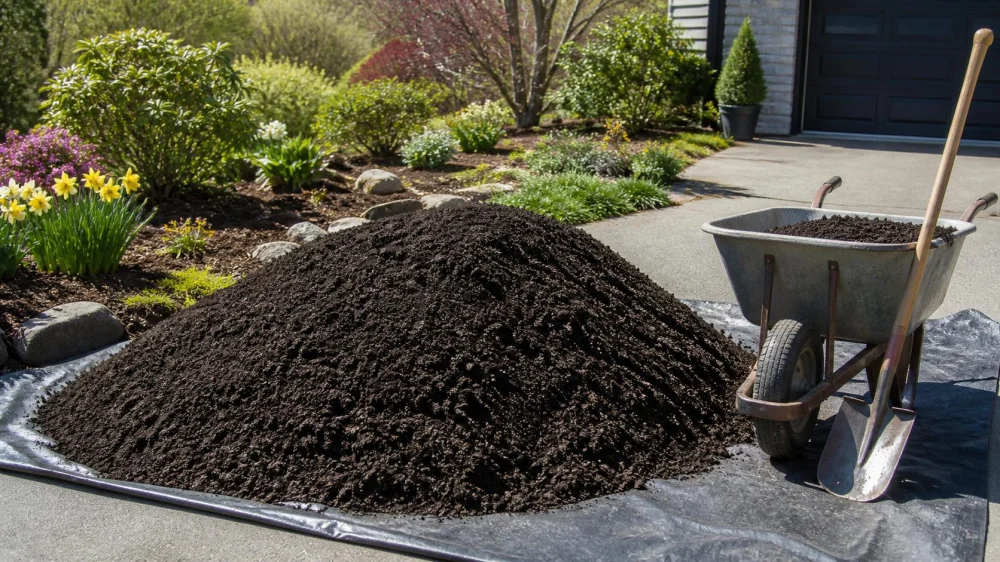
Bulk Compost Delivery: Measure Volume, Access, and Storage
On this page
Quick answer
Before ordering bulk compost, measure the beds, choose an application depth, subtract excluded areas, and confirm the supplier's unit and product description. Walk the delivery route for width, overhead clearance, slopes, pavement limits, gates, wires, trees, and underground systems. Select a dry, contained drop zone on private property, protect surfaces if appropriate, and plan to move or cover the pile promptly without blocking sidewalks, drains, hydrants, or sightlines.

Lammscapes - Landscape Design, Install & Maintenance Services
JacksonWashington CountyWisconsin
2708 Sherman Rd, Jackson, WI 53037, USA
Why it matters
A small depth error across a large bed changes volume quickly. Delivery trucks need more room and load capacity than passenger vehicles, while an uncovered pile can wash away, stain pavement, obstruct access, or heat and dry unevenly.
This United States landscape guide is general. Supplier volumes, compost maturity, nutrient analysis, local right-of-way rules, axle loads, weather, soil needs, and delivery equipment vary.
Practical checklist
- Measure each bed and remove building, path, trunk, and hardscape areas.
- Choose depth based on the specific use and soil plan.
- Convert the result into the supplier's cubic-yard or other unit and confirm rounding.
- Ask about compost feedstock, screening, maturity, test information, moisture, and contaminants.
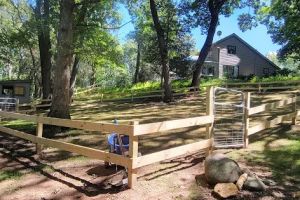
- Measure driveway width, turning room, overhead clearance, slope, and surface capacity.
- Mark a legal, level drop zone away from drains and traffic.
- Prepare tarps, covers, wheelbarrows, labor, and weather backup.
Step-by-step plan
- Sketch the beds and calculate area by simple rectangles, circles, or measured sections.
- Multiply area by the chosen depth in consistent units and add only a modest documented allowance.
- Send the supplier the address, volume, material specification, truck type, access photos, and drop-zone instructions.
- Protect vulnerable pavement or soil only with a method approved for the delivery load.
- Have an adult spot the delivery from a safe visible location without standing behind the truck.
- Contain and cover the pile as needed, keeping stormwater routes, exits, and public access open.
- Apply evenly, keep material away from trunks and structures, and save leftover compost in a managed covered pile.
Keep measurements, depth, calculation, product description, supplier test or analysis, quantity, price, delivery terms, access photos, drop location, weather, and application dates.
Limits and warning signs
A truck driver may refuse an unsafe route even after scheduling. Compost is not interchangeable with topsoil or mulch, and more is not automatically better for every planting or soil.
Pause delivery if overhead lines, soft ground, weak pavement, tight turns, pedestrians, or property boundaries create doubt. Consult the supplier, utility owner, soil professional, or municipality for access, material, contamination, or placement concerns.
Frequently asked questions
How many cubic yards do I need?
Calculate bed area times depth using consistent units, subtract exclusions, then confirm rounding with the supplier.
Can the truck dump on the street?
Only with explicit local permission; do not assume public right-of-way storage is allowed.
Should I order extra?
Use a modest allowance tied to measurement uncertainty, not an arbitrary large overage.
How long can compost sit in a pile?
Move it promptly; if it must remain, contain and cover it appropriately while keeping drainage and access clear.
Sources and evidence
The guide applies quantity takeoff, material verification, vehicle-access, surface-load, stormwater, and work-zone principles: calculate before ordering, specify the product, approve the route, contain the pile, and keep public access open.
Conclusion and next steps
Measure beds and depth, verify the compost specification and unit, walk the truck route, mark a lawful stable drop zone, and arrange labor and weather protection before delivery day.





 Trimmers Landscaping LLC5.0 (4 reviews)
 C & M Group Inc4.0 (16 reviews)
 RedStone Landscapes, LLC5.0 (1 reviews)
 Mack Landscapes4.0 (49 reviews)
 Summit Landscape and Design5.0 (55 reviews)
 Darin Warfield Lawn & Landscape0.0 (0 reviews)
 How to Map Sun and Shade Before Planning Your Landscape
 How to Choose the Right Mulch for Your Garden Beds
 Top 5 Hardscape Ideas to Transform Your Backyard
 How to Plant in Layers for Continuous Color and Interest
 Landscape Plant Warranty Checklist: Records, Care, and Claims
 DIY vs Professional Landscaping: Pros, Cons & Cost