
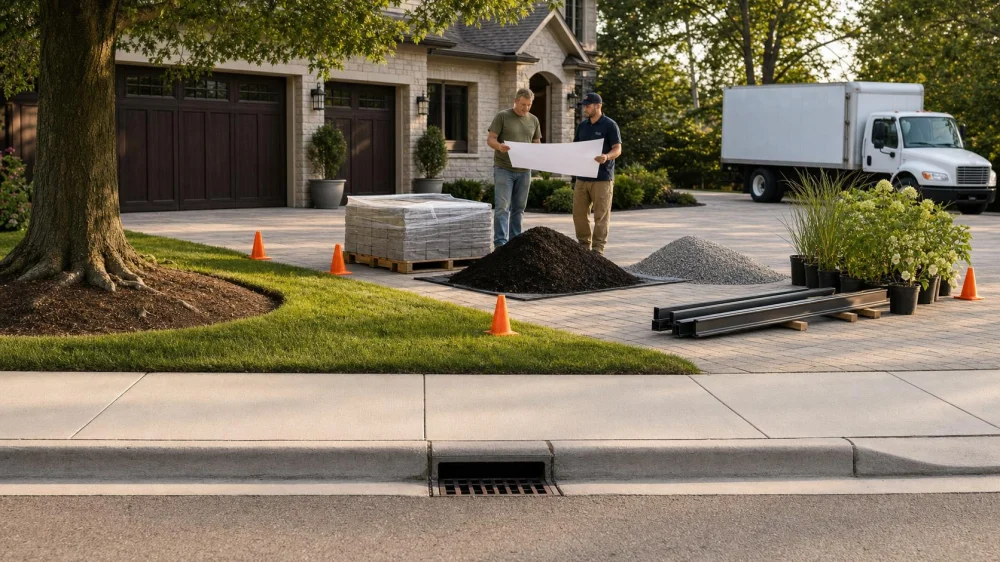
Landscape Material Delivery and Staging: A Homeowner Checklist
On this page
- Quick answer
- Plan before ordering
- Measure access and staging space
- Protect utilities and site features
- Choose a safe delivery surface
- Stage different materials correctly
- Protect delivered plants
- Manage street and neighbor impacts
- Inspect the delivery
- Prepare for weather
- Control access and secure the site
- Plan cleanup and restoration
- Delivery-day checklist
- Frequently asked questions
- Next steps
Quick answer
Before a landscape delivery, confirm what is arriving, total weight and volume, truck type, unloading method, access dimensions, surface limits, permits, utility locations, and the exact staging zone. Mark a level area that keeps materials off sidewalks, drains, lawns, septic components, tree root zones, and buried services.
Separate soil, mulch, stone, pavers, lumber, plants, and waste containers according to how they will be used. Protect surfaces with contractor-approved methods, keep pedestrian and emergency routes open, inspect quantities and damage at delivery, and photograph the site before and after. Do not direct a heavy truck onto a driveway, yard, or sidewalk unless the carrier and qualified site professional agree it can safely support the load.
Plan before ordering
Ask the landscaper or supplier for a delivery schedule, packing list, and expected vehicle. A dump truck, flatbed, boom truck, pallet jack, forklift, and small pickup need different room. Confirm whether the driver unloads only at the curb or can place material elsewhere.
Identify who has authority to direct the driver. The homeowner, contractor, supplier, and carrier should agree on the location before the truck arrives. Last-minute instructions can put a driver in an unsafe position or place material where it blocks work.
Check whether the order will arrive in one load or several. Soil and aggregate may be sold by volume or weight; pavers and stone usually arrive on heavy pallets. Plants may come from a separate nursery and require immediate care.
Confirm cancellation, waiting-time, redelivery, contamination, and return policies. Some bulk material cannot be returned after dumping, even if the color or texture differs from a sample.

Measure access and staging space
Measure gate width, driveway width, overhead clearance, turning radius, slope, and distance from the street. Include roof eaves, branches, wires, signs, basketball hoops, and parked vehicles. A truck may fit through a gate but still lack room to turn or raise a dump bed.
Ask the supplier for the vehicle’s width, height, length, and required unloading clearance. Do not estimate from a passenger vehicle. A raised dump body or boom can approach overhead utilities even when the truck itself clears them.
Calculate staging area from the delivered volume plus room to work around it. A pile spreads beyond its peak. Pallets need stable bearing and forklift access. Leave a buffer around doors, meters, hydrants, and equipment.
Plan how material moves from staging to installation. A location close to the work reduces wheelbarrow trips, but it should not trap later deliveries or force crews across newly installed areas.
Protect utilities and site features
Contact 811 before digging and follow the required waiting period in your state. Utility marks do not certify that the surface can carry a loaded truck, and private lines such as irrigation, landscape lighting, propane, septic, well, or outbuilding power may require separate locating.
Mark sprinkler heads, valve boxes, cleanouts, drain inlets, shallow pipes, invisible-fence wires, and low-voltage cables. Show the driver and crew, but do not rely on small flags alone in a busy staging area.
Keep loads and equipment away from septic tanks, drain fields, wells, retaining-wall edges, culverts, vaults, and recently excavated soil. A lid or pipe can fail under weight even if the ground looks firm.
Protect trees by keeping piles, pallets, vehicles, and grade changes outside a qualified tree-protection zone. Compaction and buried root flares can cause damage that appears long after the project.
Choose a safe delivery surface
A paved driveway is convenient but not automatically rated for a loaded truck or concentrated pallet weight. Ask about pavement thickness, age, cracks, base, slope, and underground structures. The carrier may refuse a placement if conditions are unsafe.
Do not use thin plastic sheeting as proof that a surface is protected. It may prevent staining but does not distribute weight, stop cracking, or provide traction. Plywood or ground-protection mats can also shift or fail if selected or installed incorrectly.
Grass and soil may rut, compact, or conceal irrigation. Wet ground greatly reduces bearing capacity. If off-street staging is unsuitable, ask about smaller loads, bulk bags, curbside placement, a conveyor service, or hand transfer by the contractor.
Keep material from blocking drainage. Soil, mulch, and stone can wash into a storm drain, street, or neighboring property. Use appropriate containment and follow local stormwater rules.
Stage different materials correctly
Keep soil and compost on a clean contained surface so they do not mix with gravel, pavement debris, or existing soil. Cover only when appropriate for the material and wind conditions; avoid creating trapped runoff.
Mulch can heat internally and may stain pavement. Keep it away from buildings, ignition sources, and drainage routes, and install it promptly according to supplier guidance. Do not store large piles longer than recommended.
Aggregate spreads during dumping and is difficult to move twice. Separate base stone, drainage stone, and decorative gravel with clear physical boundaries. Confirm that each load matches the order before the next is placed.
Paver and stone pallets are extremely heavy. Place them on a stable level surface with equipment access and do not stack or move them without manufacturer and contractor approval. Inspect banding but do not cut it until the crew is ready and the pallet is secure.
Lumber, edging, and long materials need level support so they do not warp or create a trip hazard. Store products according to manufacturer instructions and keep packaging intact until inspection.
Protect delivered plants
Coordinate plant delivery close to installation. Confirm botanical name, cultivar, container size, quantity, and condition against the order. Tags are useful for identification but should be checked against the invoice.
Place plants in a protected area with suitable light and wind exposure. Do not leave roots or containers in a hot enclosed vehicle, on scorching pavement, or submerged in standing water.
Water according to nursery and landscaper guidance. Different plants and root balls have different needs; automatic daily watering can be as harmful as neglect. Keep root balls shaded and intact.
Photograph broken branches, dry root balls, root defects, severe wilting, pests, or incorrect items immediately. Notify the supplier before planting if acceptance terms require inspection at delivery.
Manage street and neighbor impacts
Tell neighbors about predictable short-term noise, truck access, or parking changes. Do not reserve public curb space with unofficial cones or objects. Ask the local authority whether a permit or approved traffic control is required.
Keep mailboxes, fire hydrants, accessible routes, sidewalks, bike lanes, and emergency access clear. A spotter may be needed where a vehicle crosses a pedestrian route.
Confirm that no part of the load will be placed on a neighbor’s property or shared driveway without written agreement. Mark the property boundary if it is not obvious.
Schedule deliveries during permitted hours. Arrange for children and pets to remain indoors and away from trucks, forklifts, pallets, and loose piles.
Inspect the delivery
Meet the driver at the agreed location. Review overhead and ground hazards before unloading. Do not stand behind a truck, beneath a boom, beside an unstable pallet, or inside the equipment swing area.
Compare material type, color, size, lot, quantity, and condition to the order. Natural stone, soil, and mulch vary, but a significant mismatch should be documented before unloading when possible.
Photograph pallet labels, the load, the staging area, and visible damage without stepping into an unsafe zone. Note shortages or rejected items on delivery paperwork according to the supplier’s process.
If conditions differ from the plan—soft ground, blocked access, low wire, unstable slope—pause. Redelivery is inconvenient, but it is preferable to damaged property or injury.
Prepare for weather
Review the forecast and ground conditions. Heavy rain can wash fine material, saturate soil, weaken access, and delay installation. High wind can lift covers, packaging, or dry mulch.
Use weighted, secure covers only where the supplier recommends them. Do not create a basin that channels contaminated runoff. Keep plastic from blowing into roads, trees, or power lines.
In hot weather, prioritize live plants and heat-sensitive products. In freezing conditions, protect materials and water systems according to manufacturer and contractor guidance.
Agree in advance on who decides to postpone and what fees apply. A written weather plan reduces pressure to unload into an unsafe location.
Control access and secure the site
Loose stone, open pallets, metal edging, and equipment can injure children or pets. Use appropriate barriers and supervision without blocking exits or creating new hazards.
Store valuable fixtures, tools, and boxed products in a secure dry location. Keep receipts and serial information where applicable. Do not leave keys in equipment.
Maintain a clear walkway for occupants and workers. Provide safe night visibility if material remains outside, but do not improvise electrical cords across wet paths.
Ask the contractor who is responsible for theft, vandalism, weather damage, and material after delivery. Responsibility may change when the homeowner accepts a load.
Plan cleanup and restoration
Decide who removes pallets, banding, bags, wrap, excess soil, and damaged material. Some suppliers collect pallets; others charge a deposit or require return.
Sweep hard surfaces without washing sediment into storm drains. Use appropriate collection and disposal. Restore compacted or rutted areas as part of the project scope.
Inspect driveways, curbs, gates, plants, irrigation, and drainage after the final load. Compare with pre-delivery photographs and report damage promptly.
Remove temporary markings and barriers only after material is installed and hazards are gone. Keep utility marks long enough for all planned digging.
Delivery-day checklist
- Confirm delivery time, truck type, unloading method, and contact person.
- Measure access, turning room, overhead clearance, and staging space.
- Locate public and private utilities and mark sensitive site features.
- Verify surface capacity with qualified parties.
- Keep sidewalks, drains, hydrants, doors, and emergency routes open.
- Separate materials in installation order.
- Inspect quantities, condition, species, colors, and lot information.
- Photograph the site before unloading and after cleanup.
- Protect live plants from heat, wind, and drying.
- Pause the delivery if site conditions are unsafe.
Frequently asked questions
Can a delivery truck dump mulch on my driveway?
Only if the carrier agrees and the driveway and access can safely support the vehicle and unloading method. Surface protection does not guarantee against cracking or staining.
How much room does a bulk pile need?
It depends on volume, material, moisture, and unloading method. Ask the supplier for an estimated footprint and allow extra space around the pile for spreading and work access.
Should I cover delivered soil?
Ask the supplier and contractor. A secure cover may limit erosion or contamination, but poor covering can trap runoff, blow away, or create a hazard.
Who checks delivered plants?
Assign one person before delivery. Compare plants with the order and warranty terms, photograph condition, and report discrepancies before planting when required.
What if the driver refuses the planned location?
Do not pressure the driver. Ask for a safe alternative, smaller delivery, curbside placement, or rescheduling. The conditions observed on site can override an earlier plan.
Next steps
Obtain the packing list and vehicle requirements, then walk the access route with the landscaper. Mark utilities and protected areas, photograph existing conditions, and create a scaled staging map. Send the agreed location to the supplier before delivery and assign one person to receive and document the load.
This guide provides general planning information. Site capacity, traffic control, utility protection, and delivery methods require project-specific evaluation and compliance with local rules.






 Landscaping Tony's restoration Corp4.0 (12 reviews)
 Full Pull Construction4.0 (12 reviews)
 Greendell Landscape Solutions4.0 (121 reviews)
 Hoerr Schaudt Landscape Architects3.0 (30 reviews)
 Sanchez Lawn & Landscape LLC5.0 (96 reviews)
 Michigan Landscapers5.0 (41 reviews)
 How to Shape Garden Bed Edges for Easier Mowing
 How to Create a Landscape That’s Easy to Clean and Maintain
 How to Plan a Backyard That Balances Play and Relaxation
 How to Plan Outdoor Fire & Water Features Harmoniously for Your Garden
 How to Use Ornamental Grasses as Soft Barriers in Landscaping
 How to Landscape Around a Retaining Wall