
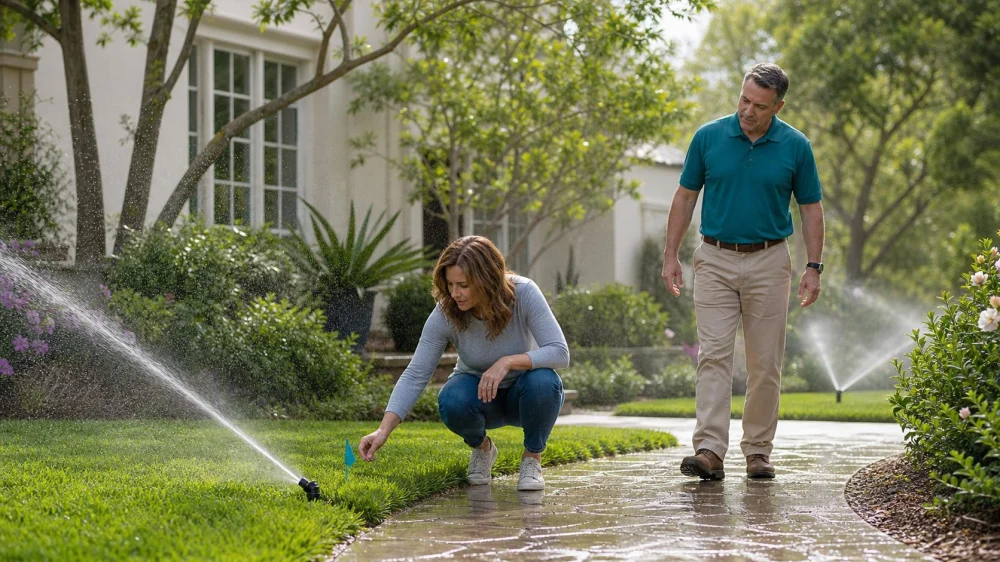
Landscape Irrigation Zone Audit: Find Leaks, Overspray, and Broken Heads
On this page
- Quick answer
- Prepare for a safe walkthrough
- Map the controller and zones
- Run and observe one zone at a time
- Check heads and spray patterns
- Look for leaks and pressure problems
- Stop runoff and hardscape watering
- Review the controller schedule
- Prioritize repairs and professional help
- Record results and recheck
Quick answer
Audit a landscape irrigation system by running one zone at a time during daylight and walking the irrigated area from a safe, dry path. Flag broken, missing, sunken, or tilted heads; misting; blocked spray; water hitting pavement or walls; pooling; bubbling soil; clogged drip emitters; and valves that do not shut off. Photograph each issue and connect it to a controller zone before changing the schedule.
Stop the system for flooding, a major line break, exposed wiring, unstable valve boxes, or water reaching electrical equipment. Small nozzle adjustments may be homeowner work when the manufacturer permits it, but buried leaks, pressure problems, wiring, valves, backflow devices, and unclear system design belong with qualified irrigation or plumbing professionals under local rules.

Prepare for a safe walkthrough
Choose daylight and calm weather so you can see spray direction without wind distorting it. Tell household members that the system will run. Keep children and pets indoors, move vehicles, and clear portable furniture without blocking sprinkler heads. Wear slip-resistant footwear and avoid walking on steep, muddy, or saturated ground.
Gather the controller manual, a site sketch, phone camera, clipboard, small marker flags, and a watch. Do not place metal tools into an energized controller, valve box, or wet electrical area. Know how to stop a manual test before starting it. If reclaimed water is used, follow all contact, signage, and cross-connection requirements.
Gielow's Outdoor Power Equipment
MilwaukeeMilwaukee CountyWisconsin
6643 N Teutonia Ave, Milwaukee, WI 53209, USA
Map the controller and zones
Controller labels are often incomplete after landscaping changes. Start each station manually for a short observation cycle and mark the beds, turf, trees, or drip lines it operates. Note spray heads, rotors, bubblers, and drip equipment separately. A zone should generally serve plants and equipment with compatible water needs and application rates.
Update names such as “front lawn,” “north shrubs,” or “side-yard drip” instead of relying only on station numbers. Record heads that unexpectedly run together, a station that does nothing, or a zone that will not turn off. Those clues can point to wiring, valve, or controller problems that need diagnosis rather than more runtime.
Run and observe one zone at a time
Watch startup, steady operation, and shutdown. During startup, look for delayed heads, geysers from missing nozzles, air or debris, and water appearing far from a head. During steady operation, walk the perimeter and then view coverage from more than one angle. At shutdown, check whether flow stops promptly or a low head continues draining.
Do not stand over a head when a zone starts. Keep your face away from pressurized components and do not remove a nozzle while the system is running. Flag an issue beside—not on top of—the component so it can be found after the water is off.
Check heads and spray patterns
Look for heads that fail to rise, lean, sit below turf, or remain stuck up after watering. Check for cracked bodies, missing nozzles, worn seals, clogged screens, grass blocking the stream, and tree roots or edging that have shifted equipment. Misting or fogging can indicate excessive pressure or an unsuitable nozzle rather than a need for longer runtime.
Spray should serve the intended planted area without soaking siding, fences, windows, streets, sidewalks, or neighboring property. One head’s pattern should complement adjacent coverage without excessive overlap. Avoid twisting a head or substituting a nozzle until you know the required arc, radius, precipitation rate, and manufacturer compatibility.
Look for leaks and pressure problems
Pooling around a head, constant sogginess between cycles, hissing, bubbling soil, a spinning meter when indoor and outdoor uses are off, or an unexpectedly high water bill can suggest a leak. Open a valve box only when it is safe and accessible; observe standing water, damaged lids, loose visible connections, or a valve that does not close. Do not reach into a flooded box with wiring.
Uneven pressure may appear as weak far-end heads, overspray near the valve, pulsing, fogging, or zones that fail when several demands overlap. Pressure must be measured and corrected using equipment appropriate to the system. Repeatedly enlarging nozzles or extending runtime can increase waste without fixing the underlying hydraulic problem.
Stop runoff and hardscape watering
Watch gutters, slopes, compacted areas, bed edges, driveways, and sidewalks. Runoff means water is being applied faster than the soil can absorb it, the schedule is too long, the head is misdirected, or drainage and grade need attention. Turn off the test before water leaves the property or creates a slippery public walkway.
EPA WaterSense’s Sprinkler Spruce-Up guidance recommends inspecting, connecting, directing, and selecting irrigation equipment. It also describes “cycle-and-soak”: shorter watering intervals separated by pauses that allow infiltration. This can help some slopes or tight soils, but it does not replace repair of leaks, broken equipment, poor grading, or an unsuitable design.
Review the controller schedule
Write down the days, start times, runtime per zone, seasonal adjustment, rain delay, sensor status, and any overlapping programs before editing. Multiple unnoticed start times can repeat the entire schedule. Match settings to local watering restrictions, current weather, soil, plant needs, shade, slope, and the actual application rate—not a neighbor’s schedule.
Confirm that a rain or soil-moisture sensor is connected and functioning according to its manual. Replace the controller backup battery when required. Smart or weather-based controllers still need correct zone information and periodic review; automation cannot compensate for a broken head or leak.
Prioritize repairs and professional help
- Shut down active line breaks, uncontrolled flow, and electrical hazards.
- Replace missing or broken components that create geysers or flooding.
- Correct leaks and valves that do not close.
- Resolve pressure, backflow, wiring, and controller faults.
- Correct overspray, blocked patterns, and mismatched equipment.
- Update scheduling only after the system operates correctly.
Call a qualified professional when repairs involve buried pipes, municipal connections, a backflow prevention assembly, shared irrigation, wiring, major roots, hardscape excavation, or diagnosis beyond the manufacturer’s homeowner instructions. EPA WaterSense maintains information on certification programs for irrigation professionals who design, install, maintain, or audit efficient systems.
Record results and recheck
Create a table with zone, location, equipment type, observed problem, photo number, urgency, planned correction, and completion date. Save invoices, parts, pressure findings, and updated controller settings. After repair, rerun the affected zone and check the adjacent zones because changed pressure or patterns can reveal a second issue.
Walk the system at the beginning of the irrigation season, after freezing weather or construction, and periodically while it is in use. Also inspect after a mower strike, unexplained wet spot, landscape renovation, or unusual bill. A brief recurring zone test catches problems that remain hidden when irrigation runs before dawn.



 Farber Bag & Supply Company, Inc.4.0 (10 reviews)
 MCA Landscaping5.0 (7 reviews)
 Lightscape Inc4.0 (11 reviews)
 Kramer Services3.0 (15 reviews)
 Extreme Green Lawn & Landscape5.0 (3 reviews)
 INNovation STUDIO LLC4.0 (11 reviews)
 How to Choose Native Shrubs That Thrive Without Fertilizer
 How to Protect Existing Trees During a Landscaping Project
 Lazy Lawn Care: How to Maintain Grass with Minimal Effort
 Best Ground Covers for Slopes & Erosion Control: Affordable and Effective Solutions
 How to Choose Drought-Resistant Grass for Your Region: Expert Tips
 How to Transition from Sod to Native Meadow