
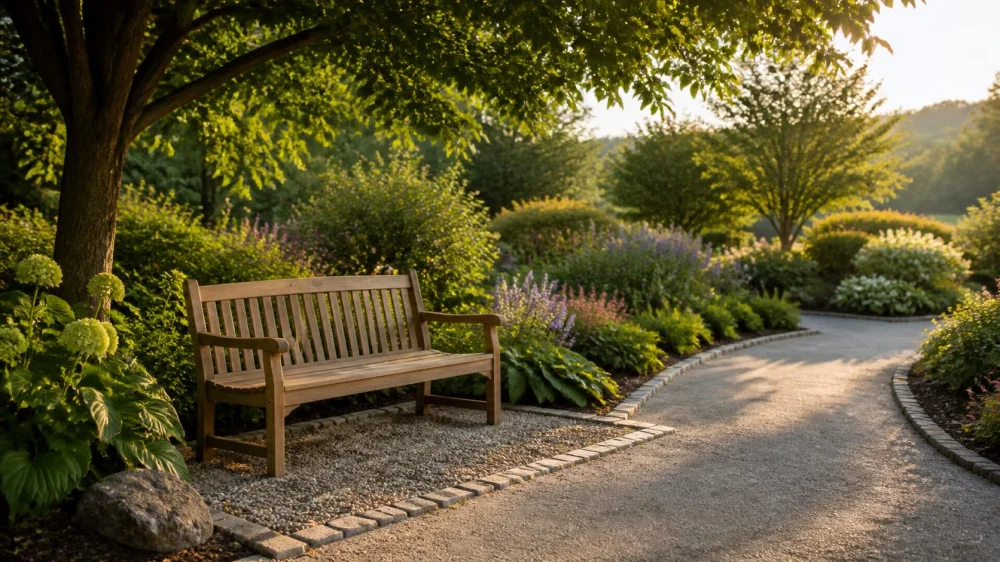
Garden Bench Placement: Plan Shade, Views, Access, and Upkeep
Table of contents
Quick answer
Place a temporary chair at the proposed bench location and test it at several times of day before building. Check shade, glare, wind, views, privacy, insects, drainage, and walking access. Leave room beside and around the seat, keep it outside path clearance, and use a stable, level, maintainable base. Confirm utilities, property lines, and applicable accessibility or construction rules before permanent anchoring.

Juan company Landscaping service
CollinsvilleMadison CountyIllinois
402 Summit Ave, Collinsville, IL 62234, USA
Choose the purpose
A bench can be a destination, a rest point, a place to supervise play, a social seat, or a visual accent. Those functions lead to different locations. A destination bench may face a garden view; a rest bench belongs along a longer route; a conversation bench needs suitable distance and orientation to other seating.
Write down who is expected to use it and for how long. Older adults may value back and arm support. A person using a mobility device may need a clear adjacent space rather than an isolated seat centered in a narrow path. Children may need supervision sightlines. Someone reading needs different shade and light from a person watching sunsets.
Decide whether the bench should be visible from the house, private from neighbors, or integrated into an entertaining area. Avoid blocking a key view merely because an empty corner seems available. The seated eye level matters more than the standing view used during design.
For public, rental, common-use, or commercial property, do not treat a residential design checklist as code advice. Accessibility, permitting, anchoring, fall-zone, fire, and property-management requirements may apply.
Test the location
Use a movable chair or mock-up for several days. Sit in the morning, midday, evening, and after rain. Observe sun angle, reflected heat, wind, street noise, sprinklers, roof runoff, and seasonal leaf drop. A comfortable spring location can be exposed in summer after the sun shifts.
Check the view from both directions. What will the seated person see, and what will people in the house see? Frame a tree, planting bed, water feature, or long axis. Screen service equipment, bins, parking, and neighboring windows with appropriate spacing rather than crowding the bench with plants.
Look overhead and uphill. Avoid placement under dead limbs, unstable trees, roof snow or ice fall, uncontrolled drainage, or a loose retaining slope. A qualified arborist, engineer, or landscape professional should evaluate uncertain hazards.
Notice insects and wildlife without relying on one brief visit. Standing water, flowering plants, outdoor food, and lighting can change activity. Do not position a seat beside a known stinging-insect nest or active wildlife route. Use safe professional help when removal is needed.
Plan access
Connect the bench to a route people can find and use. The path should be wide and stable enough for intended users, with safe drainage and no surprise step hidden by plants. Avoid making the bench itself narrow the route or force pedestrians into a planting bed.
Provide clear ground beside the bench for a mobility device, stroller, or companion chair when space allows. Keep that area connected to the route rather than separated by edging. Back support and a well-placed armrest can help some users rise, while continuous armrests on both ends can interfere with side transfers for others.
Private residential projects may not be governed by standards that apply to public or federal outdoor sites, but inclusive design principles can still improve use. For regulated sites, a qualified accessibility professional must interpret the applicable standard. Do not copy one dimension from a federal guide and assume it resolves every local requirement.
Maintain overhead and side clearance. Prune plants so branches do not strike faces or conceal the route, while using proper horticultural techniques. Keep hose routes, irrigation heads, low lighting, and edging out of the walking line.
Prepare the base
A bench on soft soil can sink, rock, or tilt. Evaluate soil, drainage, frost, slope, and the bench manufacturer's anchoring instructions. Options include a compacted aggregate pad, pavers, concrete, deck structure, or another professionally designed base. The best choice depends on load, climate, materials, and whether relocation is expected.
Do not dig or drive anchors before buried utilities are located through the relevant service. Private irrigation, low-voltage lighting, or other owner-installed lines may not be covered by public utility marking. Review site records and use qualified locating where needed.
Slope must shed water without making the seat unstable. A perfectly level-looking pad can still collect runoff if surrounding grades direct water toward it. Observe the site after rain and coordinate drainage before installation.
Anchor when required by the product, wind exposure, theft risk, public use, or local rule. Use corrosion-resistant compatible fasteners and preserve the structure beneath. Freestanding does not mean maintenance-free; check feet, joints, and level seasonally.
Manage comfort and upkeep
Bench material affects surface temperature, weight, maintenance, and lifespan. Metal can become hot or cold; dark colors absorb heat; wood may splinter or require finish; recycled plastic can expand; stone is durable but hard and difficult to move. Test a sample when possible and follow manufacturer care instructions.
Shade can come from trees, structures, or a separate canopy. Do not attach swings, shade fabric, or hardware to a tree without professional assessment. Allow mature plant size and root zones in the design. A young shrub placed close for instant screening may overtake the seat.
Plan cleaning access behind and underneath the bench. Remove leaves and debris, check for nests, tighten permitted fasteners, inspect finish, and keep the pad free of algae or ice according to safe local practices. Store cushions dry and secure them from wind.
Revisit comfort after one season. Add a companion chair, adjust planting, improve shade, or move a freestanding bench if the tested pattern changes. A location that can evolve is often more useful than a permanently anchored decorative decision made on installation day.
Limitations
This article is general residential landscape planning, not structural, arboricultural, accessibility, or code advice. Loads, anchoring, surfaces, slopes, utilities, and permitting require site-specific review. Public and commercial projects can have formal requirements.
Climate, sun, plants, wildlife, and drainage vary by location. Observe the actual site and consult qualified local professionals for hazards, regulated work, or complex access needs.
Sources and evidence
The US Access Board's federal outdoor-developed-area guidance illustrates inclusive planning concepts such as clear ground space near benches, connection to an accessible route, and the usefulness of back support and thoughtfully placed armrests. Its scope is specific; it should not be treated as a universal residential code.
Frequently asked questions
Should a garden bench face the house or garden?
Choose based on purpose. Face a focal point for quiet viewing, or angle toward the house and activity area for supervision and conversation. Test both with a chair.
How much shade does a bench need?
There is no universal amount. Observe seasonal sun and consider when the bench will be used. Afternoon shade may matter more in a hot climate than morning shade.
Can a bench sit directly on soil?
It may sink, tilt, retain moisture, or become difficult to reach. A stable, drained base generally improves use, but its design depends on the site and bench.
Should I place a bench under a tree?
Only after considering branch condition, roots, sap, fruit, insects, shade movement, and runoff. Avoid root damage and have questionable trees assessed by an arborist.
Does a home bench need accessible space?
Formal requirements vary, but clear adjacent space and a stable route can make a private garden more usable for residents and guests. Regulated projects need professional review.
When should the bench be anchored?
Follow manufacturer directions and consider wind, stability, theft, use, and local rules. Anchoring into an unknown slab or soil without checking utilities and structure is unsafe.
Conclusion
A good garden bench begins as a tested location, not a purchased object. Define its purpose, sit in the proposed spot through changing conditions, plan an inclusive route and adjacent space, and prepare a stable drained base. Allow for mature plants and ongoing cleaning. Thoughtful placement turns a bench into a place people actually use.


 Olaf Landscapng Inc3.0 (6 reviews)
 Natural Creations Landscaping Inc4.0 (9 reviews)
 Robb Brinkmann Construction, Inc.4.0 (5 reviews)
 MVP Landscape Services LLC5.0 (1 reviews)
 Ayala Landscaping5.0 (1 reviews)
 TruGreen Lawn Care4.0 (378 reviews)
 DIY vs Professional Landscaping: Pros, Cons & Cost Breakdown
 How to Prune Without Damaging Your Plants
 Tree Mulch Depth Guide: Make a Ring, Not a Volcano
 What Is Meadoscaping? A Low-Maintenance Trend for 2025
 How to Use Perennial Borders to Frame Walkways: Tips for Stunning Garden Designs
 How to Use Vertical Gardening to Max Out Small Yards