
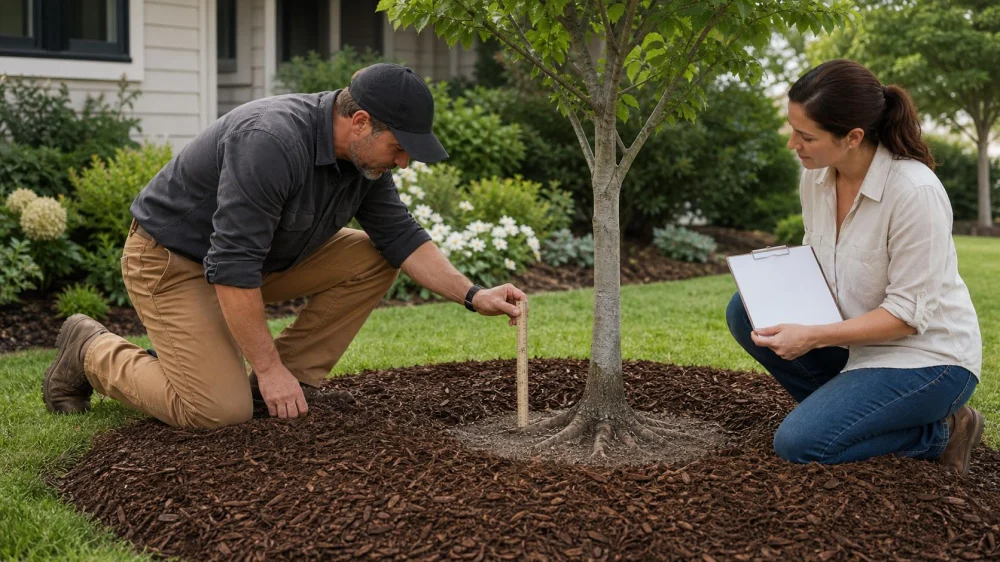
Tree Mulch Depth Guide: Make a Wide Ring, Not a Volcano
Table of contents
Quick answer
Spread organic mulch in a broad, shallow ring over the root zone, generally about two to four inches deep depending on material and local guidance. Keep it several inches away from the trunk so the root flare remains visible. Never pile mulch into a cone against bark. Measure existing mulch first, remove excess, and replenish only what has decomposed.

Bradley Landscape Services, LLC
OconomowocWaukesha CountyWisconsin
N55W34699 Lake Dr, Oconomowoc, WI 53066, USA
What mulch should do
Correct mulch moderates soil temperature, slows moisture loss, reduces weed competition, protects soil from rain impact, and keeps mowers and string trimmers away from the trunk. Organic material also breaks down gradually and can support soil structure.
More is not better. A deep, trunk-hugging pile can keep bark wet, hide decay and gnawing, interfere with gas exchange, and encourage roots to grow into the mulch rather than appropriate soil. The useful pattern looks like a wide, flat doughnut with an open center—not a volcano.

Beautiful By Design Home Development
1518 Wendy Ln, Madison, WI 53716, USA
Measure before adding more
Landscapes often receive a fresh decorative layer each year without accounting for the old material. Push a ruler through several points in the ring and record the average depth. Gently separate mulch at the trunk to locate the root flare, the widening where major roots meet the trunk.
- If depth is already adequate, fluff compacted material rather than adding more.
- If mulch is matted, loosen it without damaging shallow roots.
- If soil or mulch covers the root flare, get an arborist’s advice before digging deeply.
- If landscape fabric is exposed or girdling roots are visible, assess the whole bed design.
Apply a proper mulch ring
- Remove weeds and turf carefully without chopping tree roots.
- Expose the root flare without scraping bark or major roots.
- Spread coarse organic mulch broadly, ideally toward the canopy edge where feasible.
- Maintain a shallow, even layer based on the material and extension guidance.
- Pull mulch back from the trunk to leave a clear air gap.
- Taper the inner edge down rather than building a rim against bark.
- Water according to soil moisture and tree needs, not on an automatic assumption.
A larger diameter generally provides more root-zone and equipment protection than a small thick circle. Preserve access to irrigation emitters and do not bury trunk guards, graft unions, or utility components.
Choose suitable materials
| Material | Useful trait | Watch for |
|---|---|---|
| Arborist wood chips | Coarse, long-lasting, good soil cover | Keep off trunk and do not overapply |
| Shredded bark | Uniform appearance and availability | Matting or washing on slopes |
| Leaf mulch | Recycles local organic material | Fine layers can mat when too deep |
| Compost | Adds organic matter | Not a substitute for a durable surface layer in every site |
| Stone | Durable in selected nonplanted designs | Heat, compaction, difficult maintenance, no soil-building benefit |
Avoid contaminated material, fresh plant waste with viable invasive seeds, and mulch from diseased wood when local authorities advise against it. Match the material to climate, slope, fire-safety rules, and the tree species.
Correct a mulch volcano
Photograph the tree, then remove loose excess by hand or with a small rake working outward from the trunk. Stop if you encounter bark, fine roots growing through the pile, large girdling roots, buried hardware, or an unclear trunk flare. Aggressive excavation can cause new damage.
A certified arborist can evaluate trees that have been buried for years, show decline, lean, have cavities, or sit near targets such as a house or walkway. Correction may need to happen gradually when roots have colonized the pile.
Tree-mulching checklist
- Identify the trunk flare and keep it visible.
- Measure existing depth at several points.
- Remove weeds without damaging roots.
- Use a broad, shallow ring of suitable material.
- Leave a clear gap around bark.
- Protect the trunk from mowers and trimmers.
- Check irrigation and soil moisture under the mulch.
- Replenish based on decomposition, not the calendar.
- Inspect annually for roots, pests, decay, and settlement.
Limits and warning signs
Mulch cannot correct deep planting, compacted soil, poor drainage, trunk injury, root disease, or an undersized planting space. Yellowing, canopy thinning, mushrooms at the base, loose bark, cavities, circling roots, or a missing root flare deserve professional evaluation.
Do not cut large roots, use herbicide against trunk bark, or raise soil grade over the root system without expert guidance. In wildfire-prone regions, follow local defensible-space rules for combustible mulch near structures.
Evidence behind this guide
University extension guidance consistently recommends a shallow organic mulch layer spread widely and kept away from the trunk. The University of Minnesota describes roughly two to four inches for general mulch use and a clear trunk ring, while the University of Maryland advises one to three inches and no trunk contact. See UMN Extension mulching guidance and University of Maryland tree mulching guidance.
Frequently asked questions
Why do depth recommendations vary?
Material texture, climate, soil, plant type, and existing depth differ. Follow local extension or arborist guidance and measure rather than guessing.
Should mulch touch the trunk in winter?
No. Keep mulch away from bark year-round. A trunk pile does not provide safe winter protection.
Can I place new mulch over old mulch?
Only after measuring. If enough remains, loosen or redistribute it. Repeated top-ups can create excessive depth.
How wide should the ring be?
As broad as practical, ideally covering much of the root zone. Width is generally more helpful than extra depth.
Next steps
Inspect each tree, locate the root flare, and measure mulch depth. Pull material away from bark, spread excess outward, and add new organic mulch only where the layer is genuinely thin. Photograph the corrected ring and recheck moisture, settlement, and trunk clearance during seasonal maintenance.





 Outdoor Concepts LLC5.0 (1 reviews)
 Perfected Landscaping LLC4.0 (46 reviews)
 Chip & Co. Curbing LLC5.0 (41 reviews)
 Meisner Outdoor Services LLC5.0 (3 reviews)
 Knob Hill Landscape Co.4.0 (11 reviews)
 Meng's Landscaping and Snow Removal3.0 (7 reviews)
 How to Build an Outdoor Kitchen That Fits Into Your Garden
 How to Landscape With Large Pots and Statement Planters for Modern Homes
 How to Plan Garden Lighting to Extend Outdoor Time
 How to Protect Plants During Heat Waves
 How to Landscape for Seasonal Wildlife Attraction in Your Garden
 How to Care for a Newly Planted Landscape for Healthy Growth