
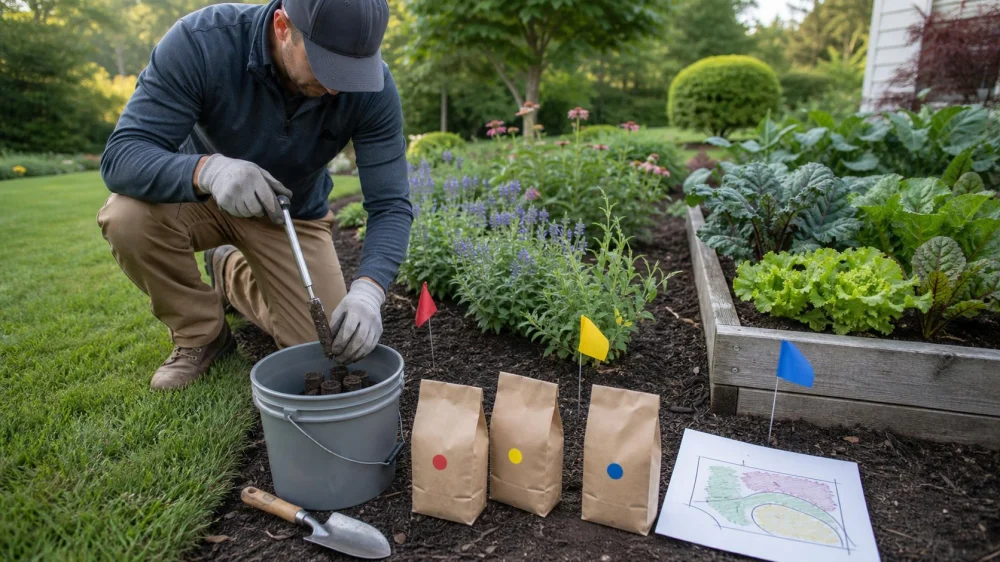
Landscape Soil Test: Sample Beds Before Adding Amendments
On this page
- Quick answer
- What a landscape soil test can tell you
- Divide the property into sampling zones
- Choose the laboratory before sampling
- Collect a representative composite sample
- Avoid misleading sample locations
- Read the report for the intended plants
- Convert recommendations into an amendment plan
- Know what a routine test does not answer
- Coordinate with a landscaper
- Soil-testing checklist
- Frequently asked questions
- Sources and evidence notes
- Conclusion and next steps
Quick answer
Test landscape soil before adding lime, sulfur, fertilizer, compost, or manure. First choose a laboratory and follow its exact instructions. Sample lawns, vegetable beds, ornamental beds, and visibly different soil as separate zones. Within one uniform zone, collect multiple equal-depth cores with clean tools, combine them in a clean container, and submit the required amount with the intended plants listed. Apply only the report-based recommendation; a routine fertility test does not automatically test contaminants, drainage, compaction, or every micronutrient.
This guide applies across the United States, but laboratories use regional methods and recommendations. The selected laboratory's depth, drying, packaging, and submission instructions take priority over general examples.

Fitzwater Outdoor Maintenance
4617 Jaysville-St Johns Rd, Greenville, OH 45331, USA
What a landscape soil test can tell you
A landscape soil test analyzes a representative sample to estimate soil properties such as pH, organic matter, and plant-available nutrients, then may recommend lime and fertilizer for a named use.
The result is a snapshot of the sampled zone, not a universal rating of the whole property. It can show that a nutrient is already sufficient, that pH adjustment may be appropriate, or that the planned amendment would add an unnecessary nutrient.
Testing is especially useful before installing a lawn or bed, changing plant type, responding to persistent performance problems, or making repeated fertilizer and lime applications.

Lawn Doctor Of Batavia-Aurora
1485 Louis Bork Dr #111, Batavia, IL 60510, USA
Divide the property into sampling zones
Separate areas that have different plants, management, soil history, or visible conditions. Common zones include lawn, vegetable garden, annual bed, perennial border, shrub bed, orchard, native planting, and a newly imported topsoil area.
Do not combine a healthy front lawn with a struggling side yard, a raised bed with native ground, or a recently fertilized strip with an untreated area. Test a suspicious patch separately so it does not dilute or distort the average for a larger zone.
Give each zone a stable name and mark it on a property sketch. Record area in square feet because application recommendations often require it.
Choose the laboratory before sampling
Start with a state university, cooperative extension, or qualified laboratory that provides recommendations for your state and intended plants. Obtain the current kit, fee schedule, test menu, sampling directions, and submission form.
Confirm what the standard package includes. pH, phosphorus, potassium, organic matter, soluble salts, texture estimates, and micronutrients vary by laboratory. Ask whether a special test is needed for a greenhouse bed, high tunnel, saline soil, compost, irrigation water, or suspected contamination.
Use the same laboratory for trend comparisons when practical because extraction methods and rating scales can differ. Do not compare numbers from two labs as though the methods are identical.
Collect a representative composite sample
A composite sample combines small cores or slices collected across one reasonably uniform zone. Follow the laboratory's required number and depth. University guidance commonly uses multiple random locations rather than one convenient scoop.
- Use clean tools and a clean plastic container unless the lab specifies otherwise.
- Remove surface litter without removing the underlying mineral soil.
- Collect each subsample to the same instructed depth.
- Take roughly equal amounts across a zigzag or distributed pattern.
- Mix the subsamples thoroughly into one composite.
- Remove stones and large debris as the lab directs.
- Air-dry only if instructed; do not heat the soil.
- Submit the requested amount in the approved bag or container.
Clean tools between zones so fertilizer, lime, rust, compost, or soil from one area does not contaminate another.
Avoid misleading sample locations
Skip unusual spots when the goal is an average zone sample: next to a fertilizer spill, compost pile, burn area, pet waste, road salt pile, downspout outlet, foundation, driveway edge, treated utility pole, or recently limed patch.
If an unusual spot is the problem you want to investigate, sample it separately and tell the laboratory why. Also collect a comparison sample from a nearby area that appears normal if the lab or extension adviser recommends it.
Do not sample immediately after adding amendments unless the laboratory instructs you to evaluate that application. Record the dates and products used so the result has context.
Read the report for the intended plants
Check that the report shows the correct zone, crop or landscape use, sample depth, and area. A recommendation for turf may not fit acid-loving shrubs, vegetables, or native plants.
Read pH separately from nutrient results. Lime recommendations depend on more than the current pH number and can involve buffer measurements and soil properties. Do not calculate lime from a generic internet chart when the lab supplies a recommendation.
Look for categories such as low, optimum, or excessive and for actual application units. Distinguish pounds of nutrient from pounds of a fertilizer product. Ask the laboratory or extension office to clarify conversions before buying materials.
Convert recommendations into an amendment plan
Measure the zone area and match a product's guaranteed analysis to the report's nutrient recommendation. A fertilizer with the wrong nutrient ratio can overapply one nutrient while failing to supply another.
Treat compost and manure as materials that can supply nutrients, not as harmless filler. Their nutrient and salt content varies. Use a compost or manure analysis when the project scale or report calls for it.
Plan timing, incorporation depth, irrigation, personal protective equipment, setbacks, and maximum application rates from the soil report, product label, plant needs, and local rules. More is not better; excess amendments can harm plants and water quality.
Know what a routine test does not answer
A routine fertility test may not measure lead, arsenic, petroleum, pesticides, pathogens, asbestos, or other contaminants. Tell the lab about the site's history and ask for the correct environmental or public-health pathway when contamination is suspected.
Laboratory nutrient results also do not replace field checks for drainage, compaction, layering, construction debris, erosion, irrigation coverage, root competition, shade, or plant disease. A plant can struggle even when nutrient values look adequate.
Do not taste soil or use home color kits as proof that food gardening is safe on a site with unknown fill, peeling exterior paint, industrial history, or a reported spill. Consult local official guidance.
Coordinate with a landscaper
Give bidders the zone map, laboratory report, intended plant list, and relevant site history. Ask each contractor to show how the proposed soil preparation matches the recommendations.
The written scope should name the amendment, product analysis or specification, rate, zone, area, depth or placement method, timing, and who verifies completion. Avoid a vague allowance for “rich topsoil and fertilizer.”
If the contractor proposes a different material or rate, ask for the reasoning and revised nutrient calculation before approval. Keep delivery tickets, product labels, photos, and final quantities with the soil report.
Soil-testing checklist
- Choose the laboratory and test package before collecting soil.
- Divide lawn, food garden, ornamental beds, and different problem areas.
- Label a property map with stable zone names and square footage.
- Follow the lab's number, depth, tools, drying, packaging, and form instructions.
- Avoid abnormal spots or sample them as separate investigations.
- List intended plants and recent lime, fertilizer, compost, and manure use.
- Confirm which properties and contaminants the selected test does and does not measure.
- Translate nutrient recommendations into actual product quantities carefully.
- Document contractor materials, rates, zones, and final application.
Frequently asked questions
Can I send one sample for my whole yard?
Only if the area is reasonably uniform in plants, soil, and management. Lawns, gardens, beds, imported soil, and visibly different areas usually need separate samples.
How deep should I sample?
Use the selected laboratory's instructions for the intended landscape use. Lawn and garden depths often differ, and consistent depth matters.
Should I add compost before the test?
Usually test first so the result represents the current soil, unless the laboratory or project adviser specifies another sequence. Record any recent additions.
Does a normal result prove the soil has no contamination?
No. A standard fertility panel may not test contaminants. Ask the laboratory and appropriate local agency which analysis fits the site history and planned use.
Sources and evidence notes
Penn State Extension describes soil testing as a tool for fertility, lime, and fertilizer decisions and instructs gardeners to combine multiple same-depth cores into a representative sample. See Penn State soil testing guidance.
The University of Minnesota Extension soil-testing guide emphasizes sampling several places, keeping raised beds distinct, and using results to choose amendments. Exact protocols and interpretations remain laboratory- and region-specific.
Conclusion and next steps
Good amendment decisions begin with a representative zone, not a single scoop. Choose the lab first, separate different landscape uses, collect equal-depth subsamples, and identify the intended plants. Then translate the report carefully and document the materials applied. When the question involves contamination, drainage, or compaction, use the appropriate separate test or field assessment instead of stretching a routine fertility report beyond its limits.



 Signature Lawn Care5.0 (3 reviews)
 Scaravalle Company4.0 (35 reviews)
 Niesen & Son Landscaping Inc5.0 (5 reviews)
 Hittle Landscaping, Inc3.0 (132 reviews)
 Stone Hill Landscaping1.0 (1 reviews)
 J.Perez Landscaping Inc.5.0 (3 reviews)
 How to Add Drama With Tall Grasses and Sculptural Plants
 How to Choose Hardscape Materials for Slip Resistance
 How to Maintain Stone and Brick Pathways Effectively
 How to Plan a Garden in Phases to Spread Cost
 How to Design a Courtyard With Water-Wise Plants
 How to Create a Nighttime Garden Experience