
Front Yard Privacy Planting: Plan Before You Buy
On this page
Quick answer
Plan privacy from the viewing position, not from a plant label. Mark the window, porch, sidewalk, or neighboring view you want to soften; measure the required screen height and width; then map sunlight, drainage, utilities, sight triangles, access, and property boundaries. Choose plants for mature size and local growing conditions. A staggered, layered group often adapts better than a single tightly spaced row.
This guide is for U.S. homeowners beginning a landscape plan. Local codes, homeowner association rules, easements, underground utilities, wildfire guidance, and plant suitability vary. Confirm them before purchase or digging.
Premier Outdoor Services LLC
SheboyganSheboygan CountyWisconsin
1999 Garton Rd, Sheboygan, WI 53083, USA
Define the privacy problem
Privacy planting uses vegetation to interrupt a specific sightline while supporting safe access, healthy plant growth, and the surrounding landscape. It is not automatically a tall hedge along every boundary.
Stand where privacy matters and identify the view: seated on a porch, inside a window, at an outdoor dining area, or along a walkway. Then observe the viewer’s likely position. A low planting close to the seating area may block a view that would require a much taller plant at the property line.
Decide whether the need is year-round screening, summer leaf cover, glare reduction, a softer boundary, or partial separation. Keep safety views open near driveways, sidewalks, intersections, doors, and paths.
Escalante Landscaping, LLC
LafayetteTippecanoe CountyIndiana
1245 Southlea Dr, Lafayette, IN 47909, USA
Map the site and constraints
Measure bed length and depth, distance to structures, and the available root and canopy space. Record direct sun at several times, soil drainage after rain, wind exposure, roof runoff, irrigation coverage, and snow or salt exposure where relevant.
Locate property boundaries using reliable records or professional help when uncertain. Mark utility equipment, meters, hydrants, drains, vents, windows, overhead lines, and access routes. Contact the appropriate utility-location service before digging; privately installed lines may require separate locating.
Check municipal and community rules for plant height, corner visibility, easements, right-of-way planting, fences, and protected areas. Do not assume an existing mow line or fence marks the legal boundary.
Choose plants by mature behavior
Compare the plant’s expected mature height and width in conditions similar to the site. Also evaluate growth habit, root space, pruning response, leaf retention, drought or wet-soil tolerance, local pest pressure, and whether the species is considered invasive or discouraged locally.
Evergreen foliage can provide year-round screening but may cast winter shade or hold snow. Deciduous shrubs can offer flowers, seasonal texture, and summer cover while allowing winter light. Mixed plantings may reduce the visual impact if one plant declines, but every species still needs compatible care.
Avoid choosing only by the size in the nursery pot. Fast growth can mean frequent pruning, weak structure, or more water and space than the site can support. Regional extension guidance, reputable nurseries, and landscape professionals can help narrow locally appropriate choices.
Build a layered design
Place the structural layer where it can reach its natural form without crowding a wall, sidewalk, driveway, or neighboring property. Add medium shrubs or grasses to fill lower sightlines, then use smaller plants at the front edge where they will not block access.
Staggering plants can create depth and close oblique views without forming one dense wall. Repeat a limited group of shapes or foliage colors so a mixed screen still looks intentional.
Leave working space for pruning, inspection, window access, meters, utility service, drainage, and exterior maintenance. Keep foliage away from vents and equipment clearances, and consider how fallen leaves, fruit, thorns, or branches will affect sidewalks and parked vehicles.
Test the layout before planting
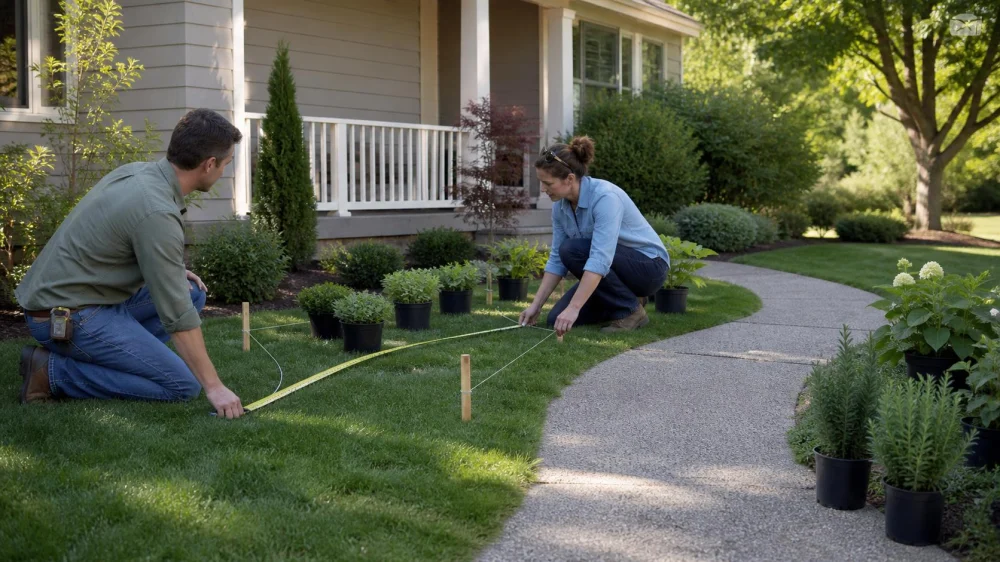
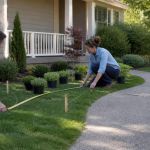
- Mark the bed. Use a hose, flags, or removable marking method without digging.
- Place height markers. Use stakes to represent mature height and width, not current nursery size.
- Check key views. Look from the porch, windows, street, driveway, and neighboring approach.
- Test movement. Walk the path, open gates, move bins, and confirm service access.
- Recheck safety. Sit in a vehicle at the driveway and verify pedestrian and traffic visibility.
- Estimate care. Confirm watering access, pruning reach, mulch area, and leaf cleanup.
- Wait a day. Review the markers under different light before purchasing.
Pre-purchase checklist
- Exact sightline, viewing height, and season of privacy defined
- Property boundary, easements, and local restrictions checked
- Public and private utilities located before digging
- Sun, drainage, wind, runoff, and available soil volume recorded
- Mature plant height, width, and maintenance needs compared
- Local invasiveness and suitability checked
- Driveway, sidewalk, doorway, window, and street views preserved
- Utility, drainage, and building-maintenance access retained
- Establishment watering plan ready
Limitations and important notes
- Published plant sizes are estimates, not guaranteed dimensions.
- A living screen takes time to establish and can develop gaps or decline.
- Planting cannot resolve a legal boundary or neighbor dispute.
- Do not block fire access, utilities, address visibility, drainage, or required sightlines.
- Regional drought, wildfire, storm, wildlife, and invasive-species guidance may change the appropriate design.
Frequently asked questions
How close should privacy shrubs be planted?
Spacing depends on mature width, growth habit, airflow, access, and the desired overlap. Use locally relevant plant guidance rather than a universal distance.
Are evergreens always best for privacy?
No. They provide year-round foliage, but site conditions, shade, snow, water needs, mature size, and desired seasonal light may make deciduous or mixed planting more appropriate.
Can I plant on the property line?
Confirm the legal boundary, easements, right-of-way rules, and maintenance access first. A setback inside your property may prevent future conflict and crowding.
How can I get privacy while plants grow?
Use a phased plan and consider a code-compliant temporary or permanent structure if appropriate. Do not crowd plants for instant density; the mature screen needs room.
Should all plants be the same species?
A single species can create uniformity, while a compatible mixture can add resilience and seasonal interest. The best choice depends on site conditions and maintenance capacity.
Sources and evidence notes
This article reflects general landscape planning practice: define the view, inventory site constraints, select plants by mature characteristics and local suitability, test the layout, preserve safety and access, and plan establishment care. Exact plant choices and legal requirements need current local information and site evaluation.
Next steps
Take photos from the places where privacy matters, draw the property edge and fixed features, and mark the required screen on the ground with removable stakes. Verify utilities and rules, then compare a short list of locally suitable plants by mature size and care. Purchase only after the full-size layout works from every important view.
 DC Landscape LLC5.0 (2 reviews)
 Custom Lawn Care LLC5.0 (3 reviews)
 L & J landscaping & lawn care snow removal LLC4.0 (56 reviews)
 Timber Crest Landscaping4.0 (36 reviews)
 Paulin's Landscaping5.0 (4 reviews)
 Sebert Landscape4.0 (15 reviews)
 How to Landscape With Large Pots and Statement Planters for Modern Homes
 Front Yard Privacy Planting: Plan Before You Buy
 How to Use Lighting to Highlight Trees and Focal Plants
 How to Design for Low-Light Outdoor Areas
 How to Choose Between Bark, Gravel, or Rubber Mulch for Landscaping
 How to Choose Mulch Based on Soil Type