
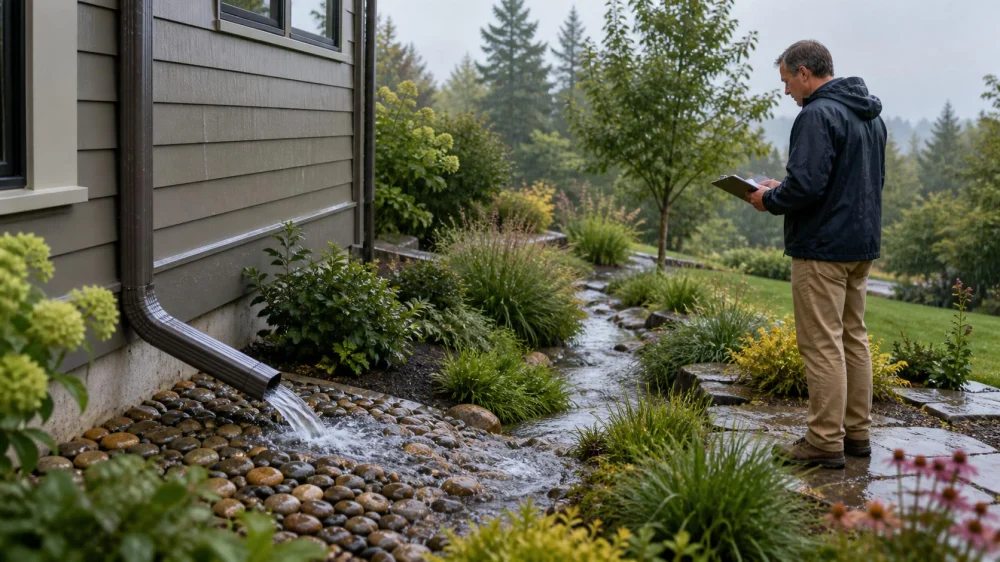
Downspout Into the Landscape: Plan the Outlet Before Redirecting Water
On this page
Quick answer
Before redirecting a downspout into a lawn or planting bed, identify the roof area it drains, observe the existing outlet during rain, confirm the ground slopes away from the building, and choose a route that will not wet the foundation, cross a walkway, erode soil, flood a neighbor, or overload a low spot. Check local drainage and downspout-disconnection rules first.
A landscaped outlet needs a stable connection, enough discharge area, erosion protection, a visible overflow route, and ongoing access for cleaning. A decorative bed is not automatically a safe place for concentrated roof water.

Coventry Gardeners & Landscaping, Ltd
414 Plaza Dr STE 101, Westmont, IL 60559, USA
Measure the roof-water route
Sketch the roof section, gutter, downspout, paved surfaces, foundation, basement or crawlspace, utilities, property line, slope, drains, wells, septic components, retaining walls, and proposed planting area. Photograph the area dry and during moderate rain. Look for gutter overflow, leaking joints, soil scour, standing water, wet foundation surfaces, and water moving back toward the house.
Ask whether the downspout connects to a storm drain, sanitary sewer, dry well, or unknown buried pipe. Do not disconnect an unknown system until the owner, utility, municipality, or qualified contractor confirms what it serves and whether permission is required.

Choose a safe destination
The U.S. Environmental Protection Agency explains that redirecting downspouts to lawn, garden, a rain barrel, or another pervious area can reduce runoff, while warning that it is not appropriate everywhere. Review EPA’s downspout redirection overview.
Select a destination with adequate infiltration and a safe overflow path. Keep discharge away from foundations and neighboring property according to local standards. Avoid steep, compacted, contaminated, unstable, or chronically saturated soil. Do not route water across steps, accessible paths, driveways, or winter icing zones. Protect sensitive plants from repeated concentrated flows.
Build and protect the outlet
- Correct gutter sag, blockage, and leaking seams before changing the outlet.
- Use compatible, securely fastened fittings and preserve access for maintenance.
- Maintain a continuous route that does not trap water or create a trip hazard.
- Spread flow with a stable splash block, level spreader, stone apron, or designed vegetated feature suited to the volume.
- Stabilize exposed soil immediately and protect mulch from washing away.
- Provide an overflow route that remains visible and does not point toward a building.
- Mark buried utilities and obtain any required permit before digging.
Rain barrels need a screened inlet, stable base, controlled overflow, and a seasonal maintenance plan. Stored roof runoff is not automatically safe for drinking or every garden use.
Test in real rain
After installation, observe several storms of different intensity. Check the connection, outlet, soil, nearby path, foundation, basement, property line, and overflow. Record rainfall when practical and take repeat photos from the same locations. Correct ponding, scour, settlement, splashback, or reverse flow promptly.
Clean gutters and strainers on a condition-based schedule, especially after leaf fall and wind. Inspect after construction, freeze-thaw cycles, mowing damage, and major storms. Plants may slow water, but they do not replace correct grading, soil capacity, or safe overflow design.
Planning checklist
- Roof section and existing connection identified
- Local drainage and disconnection rules checked
- Slope and infiltration conditions assessed
- Foundation, paths, neighbors, and utilities protected
- Outlet sized and stabilized for concentrated flow
- Overflow route remains visible and safe
- Rain barrel overflow and mosquito screening planned
- Dry-weather and storm photos saved
- Maintenance owner and schedule assigned
Limitations
This article cannot size a drainage system or determine a safe setback. Roof area, rainfall intensity, soil, slope, frost, foundations, local codes, and neighboring drainage rights vary. Get site-specific engineering or landscape drainage advice for recurring water entry, unstable slopes, large roofs, retaining walls, or unclear buried connections.
FAQ
Can the downspout end in mulch?
Loose mulch alone may float or erode. The outlet needs stable energy dissipation and a safe flow route.
Is a rain garden always suitable?
No. Soil infiltration, setbacks, utilities, overflow, groundwater, and local rules must be evaluated.
Can I disconnect a buried downspout myself?
First identify the connection and obtain required approval. An unknown pipe may serve a regulated or essential system.
What if water reaches the foundation?
Redirect flow away immediately and have grading, gutters, drainage, and any interior water entry assessed.
Evidence notes
EPA supports routing roof runoff to suitable pervious areas or storage to reduce runoff, while explicitly noting that disconnection is not appropriate at every location. Site evidence includes the roof-area sketch, grade observations, soil and utility information, permits, storm photos, overflow path, and post-installation inspection log.
Conclusion
A successful landscaped downspout outlet moves water away from vulnerable places without creating a new erosion, icing, or flooding problem. Map the whole route, confirm rules and capacity, stabilize the outlet, preserve overflow, and verify performance during real rain.






 LJ Landscaping Inc5.0 (9 reviews)
 Premier Service3.0 (38 reviews)
 Sweet Creek Landscaping5.0 (3 reviews)
 Garden Gate Landscaping Ltd5.0 (3 reviews)
 Nic Ehr Landscape Co Inc5.0 (3 reviews)
 Walmart Patio & Garden Services0.0 (0 reviews)
 How to Plan Garden Lighting to Extend Outdoor Time
 How to Build a Stone Retaining Wall That Looks Natural
 How to Landscape in Rocky or Stony Soil
 How to Use Groundcovers as a Living Mulch
 Best Native Plants for Drought-Tolerant Landscaping – Smart Water-Saving Garden Guide
 htmlCopy codeHow to Create a Bee-Friendly Yard Without Attracting Pests