
Verify a Landscaper Before Your Yard Project Starts
On this page
Quick answer
Before landscaping begins, match the contractor's legal business name, address, required license or registration, insurance, and payment recipient through independent sources. Verify additional credentials for irrigation, electrical, pesticide, tree, drainage, or structural work when applicable. Compare relevant completed projects, inspect the site together, and put scope, materials, access, permits, milestones, cleanup, changes, and warranties in writing.
Verify identity and scope-specific credentials
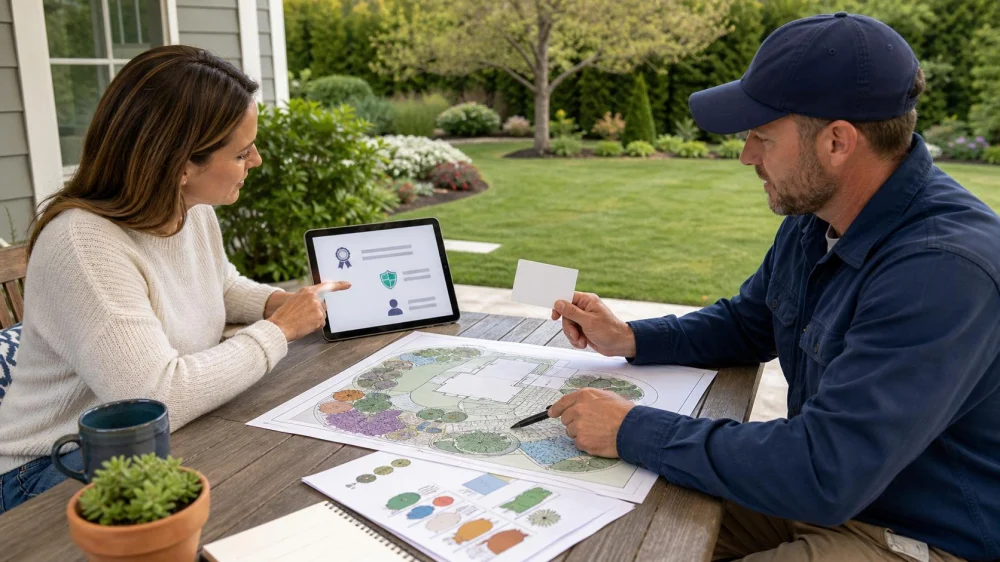
Landscaper verification is the process of confirming who will perform the project and whether the business and workers meet requirements for the location and work type. Rules vary widely across the United States.
Start with the exact scope. General planting or maintenance may be regulated differently from grading, retaining walls, decks, fences, irrigation connections, low-voltage lighting, pesticide application, tree removal, drainage, excavation, or work near utilities.
Use the appropriate official state, tribal, county, city, agriculture, pesticide, electrical, plumbing, arborist, or contractor authority. Match:
- legal business and trade names;
- physical address and independently verified contact details;
- required license, registration, category, status, and responsible person;
- public restrictions or enforcement records when available;
- the company named on the proposal and payment instructions; and
- the party responsible for permits and inspections.
Confirm insurance and the working team
Ask for insurance appropriate to the work and confirm current details with the insurer or agent through an independently obtained contact. Understand who is covered, the policy period, and whether requested activities or vehicles need separate coverage.
Ask who will be onsite:
- company employees, temporary labor, specialty subcontractors, or independent crews;
- the supervisor and daily decision-maker;
- the licensed or certified person responsible for regulated work;
- who controls keys, gates, codes, equipment, and material deliveries;
- who communicates schedule changes and neighbor impacts; and
- who handles damage, injury, utility contact, or an unexpected condition.
Require approval before an undisclosed subcontractor changes the company, credential, insurance, price, or responsibility you evaluated.

Al's Lawn Ornaments
Wisconsin RapidsWood CountyWisconsin
8811 State Hwy 13, Wisconsin Rapids, WI 54494, USA
Check relevant experience and the site plan
Review projects similar in climate, soil, slope, drainage, access, scale, material, and maintenance level—not only attractive photographs. Ask references about communication, plant substitutions, hidden conditions, cleanup, corrections, and how the landscape performed after a season.
Walk the site with the estimator. Mark property boundaries, utilities, easements, drainage paths, roots, irrigation, septic areas, structures, gates, overhead limits, protected plants, pets, children, and surfaces that need protection.
Request a scaled or clearly dimensioned plan when layout matters. It should identify quantities, plant names and sizes, material specifications, grades, drainage outlets, hardscape base, irrigation zones, lighting, demolition, disposal, restoration, and exclusions appropriate to the project.
Review contract, permits, and payment
The written agreement should connect price to deliverables. Include start conditions, schedule assumptions, weather delays, access, storage, protection, plant care, inspection, establishment period, cleanup, warranties, customer duties, and change-order approval.
Ask the authority having jurisdiction whether permits, utility location, association approval, environmental review, tree permission, or inspections apply. Record who obtains and closes each item.
Use traceable payments to the verified business and tie progress payments to observable milestones. Be cautious with large unprotected deposits, cash-only demands, changed bank instructions, or payment to an unrelated person. Ask about lien rules and waivers from a qualified local source when relevant.
Use a landscaper verification checklist
- Define the exact scope. Separate planting, hardscape, irrigation, electrical, tree, pesticide, and drainage work.
- Identify applicable authorities.
- Match business and credentials.
- Confirm insurance independently.
- Identify employees and subcontractors.
- Review comparable work and references.
- Walk and document the site.
- Align plan, contract, permits, milestones, and payments.
- Approve changes only in writing.
Limitations and safety notes
- Contractor, business, pesticide, tree, irrigation, electrical, plumbing, environmental, permit, lien, and insurance rules vary by location and scope.
- This article provides general consumer and project-planning guidance, not legal, engineering, horticultural, pesticide, insurance, or licensing advice.
- Use the official utility-location process before excavation and keep people away from active equipment and trenches.
- Some slopes, walls, drainage, structures, trees, utilities, or contaminated soils require qualified specialists.
- Do not rely on a directory badge, review site, uniform, truck, or portfolio alone as proof of current credentials.
Frequently asked questions
Does every landscaper need the same contractor license?
No. Requirements depend on location, project value, and work type. Ask the relevant authority about each part of the proposed scope.
Is general liability insurance enough?
Not necessarily. Workers, vehicles, professional design, pesticides, subcontractors, and specialty work may raise different questions. Obtain qualified local advice.
Should I check references from several years ago?
Recent references show current operations, while older comparable projects can reveal plant establishment and material performance. Use both when practical.
Who should pull landscaping permits?
The authority defines who may apply. Assign application, fees, inspections, corrections, and final closure in the contract.
What if the crew onsite is from another company?
Pause and ask whether it is an approved subcontractor. Verify responsibility, credentials, insurance, supervision, and contract terms before work continues.
Conclusion and next steps
Break the yard project into regulated and ordinary tasks, then verify the business and responsible specialists for each. Confirm insurance and team structure, document the site, and align the plan, contract, permits, and payments. A trustworthy provider should make responsibility easier to trace, not harder.
Evidence note: These recommendations reflect common contractor-verification, landscape-planning, insurance, permitting, utility-safety, and consumer-contract practices. Current authority comes from regulators, official records, qualified professionals, contracts, and site facts.




 Meyer Exteriors4.0 (8 reviews)
 The Secret Garden4.0 (25 reviews)
 M & J Landscaping Perez LLC4.0 (19 reviews)
 Global Tech Hydroseeding Erosion Control5.0 (1 reviews)
 Warsaw Siding Supply Co.0.0 (0 reviews)
 David J. Frank Landscape Contracting5.0 (2 reviews)
 How to Build a Vertical Herb Wall for Cooking Convenience at Home
 How to Landscape With Large Pots and Statement Planters for Modern Homes
 How to Create a Nighttime Garden Experience
 How to Add Drama With Tall Grasses and Sculptural Plants
 Contemporary Hardscape Trends to Watch in 2025 for Modern Outdoor Living
 Best Ways to Stage Your Front Yard for Curb Appeal