
Rain Garden Planning: Test Drainage Before You Dig
On this page
- Quick answer
- Map the runoff source
- Rule out unsafe locations
- Test soil infiltration
- Size the garden for the drainage area
- Plan a stable overflow route
- Match plants to wet and dry zones
- Plan maintenance before installation
- Rain garden planning checklist
- Frequently asked questions
- Sources and evidence notes
- Conclusion and next steps
Quick answer
A rain garden is a shallow planted depression that receives runoff from a roof, driveway, or other hard surface and lets water soak into soil. It is not simply a garden placed in an existing wet spot. Before digging, map where water comes from and where overflow can go, check setbacks and permits, locate underground utilities, assess slope and soil, and perform the infiltration test specified by local guidance.
Keep infiltration away from foundations, basements, septic systems, wells, contaminated soil, steep slopes, unstable areas, and buried utilities as local rules require. If water does not drain within the allowed time, or the project needs an underdrain, engineered soil, retaining structure, or large drainage area, use a qualified stormwater or landscape professional.

Map the runoff source
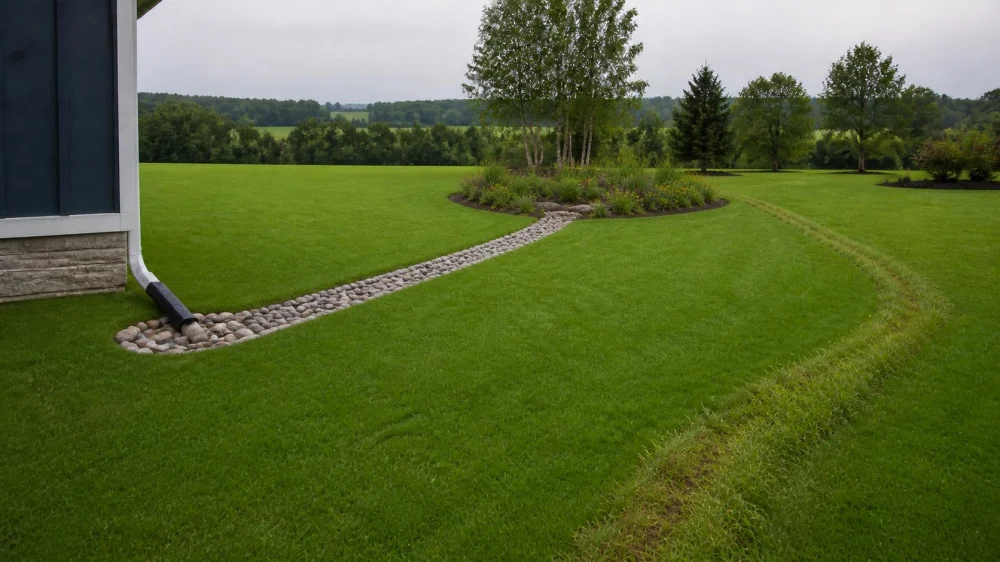
Observe the property during more than one rain. Mark downspouts, roof areas, pavement, compacted paths, slopes, property boundaries, existing drains, erosion, ponding, and the final discharge point. Photograph flow direction from a safe location and note whether runoff crosses a neighbor’s property or public sidewalk.
Estimate the impervious area feeding the proposed garden rather than using total lot size. A roof downspout may drain only one roof section. The contributing area, local rainfall, soil infiltration, garden depth, and overflow design work together; a decorative guess can create chronic ponding or send water toward a building.

Rule out unsafe locations
EPA rain-garden resources emphasize accurate underground-utility information and locations to avoid. Contact 811 and any local private-utility locator before excavation, and confirm easements. Do not assume the public mark covers irrigation, low-voltage lighting, private gas or power, septic lines, or other owner-installed systems.
Check required distances from structures, retaining walls, septic systems, drinking-water wells, property lines, trees, slopes, and contaminated or formerly industrial ground. Avoid excavating inside critical tree-root zones without an arborist. Existing ponding can signal slow soil or a high water table rather than an ideal rain-garden site.
Test soil infiltration
Use the test method and pass/fail threshold required by the local stormwater or extension program. The procedure may specify hole size, depth, pre-soaking, repeated measurements, and how to calculate a rate. A one-time observation after a dry week is not enough when the design standard calls for a formal test.
EPA’s semi-arid toolbox notes that a typical rain garden without an underdrain must be evaluated for soil permeability and gives an example target of draining dry within 6–12 hours with infiltration around 0.5 inch per hour or greater. That is an example, not a universal rule. Local soil, groundwater, frost, rainfall, and regulation determine the project standard.
Size the garden for the drainage area
Local manuals often use a ratio between the garden surface and the impervious area that drains to it, adjusted for soil and depth. Measure rather than eyeball. Confirm whether gutters, driveways, or adjacent slopes will add water and whether future roof or paving work changes the load.
Keep the bottom level so water spreads rather than concentrating at one edge. Side slopes must be stable and maintainable. Do not increase depth to compensate for too little area without professional review; deeper water can create safety, plant, drainage, and regulatory issues.
Plan a stable overflow route
Every rain garden can receive a storm larger than its design event. Provide a defined, erosion-resistant overflow path that moves excess water away from buildings, septic areas, slopes, neighboring property, and unsafe walking surfaces toward an approved discharge point.
Set the overflow elevation before planting and protect the inlet from erosion. Use level spreaders, stone, dense vegetation, or another detail specified by the design. Never block a legal drainage path or direct water into a sanitary sewer. Ask the municipality where stormwater may discharge.
Match plants to wet and dry zones
The garden bottom experiences short wet periods followed by drying, while side slopes and rim are usually drier. Select plants that tolerate the moisture pattern, sun, soil, winter low, summer heat, salt exposure, mature size, and local ecological goals. Local extension and conservation programs can provide regional lists.
Place taller or spreading plants where they will not block sightlines, sidewalks, utilities, or maintenance access. Avoid invasive species. A rain garden still needs establishment watering and weed control; “native” does not mean every plant thrives in every local site or requires no care.
Plan maintenance before installation
Provide access to remove sediment and litter from the inlet, weed, replace plants, refresh mulch if specified, and inspect overflow. Mark utilities and pipes on an as-built sketch. Establish who checks the garden after large storms and what counts as unacceptable standing water.
During the first seasons, track drainage time, erosion, bare soil, plant survival, and unintended flow. Do not solve recurring ponding by adding pesticide or random soil amendment. Stop inflow and obtain design help if the garden sends water toward a structure, remains wet beyond the local limit, exposes utilities, or erodes.
Rain garden planning checklist
- Observe runoff during several storms.
- Measure the actual impervious drainage area.
- Check local permits, setbacks, and design manuals.
- Locate public and private underground utilities.
- Rule out foundations, septic, wells, contamination, and unstable slopes.
- Perform the required infiltration test.
- Size and level the garden using local criteria.
- Design a safe, stable overflow route.
- Select plants for bottom, slope, and rim conditions.
- Plan access, inspection, weeding, and sediment removal.
Frequently asked questions
Is an existing puddle the best location?
Not necessarily. Ponding may indicate slow infiltration or a high water table.
Can I put a rain garden beside the foundation?
Use required local setbacks. Infiltration near basements or foundations can create water intrusion.
Do I need to call 811?
Yes, before digging, and also identify private utilities not covered by public marking.
Should a rain garden hold water all the time?
No. It should drain within the time specified by the local design standard.
What happens during a very large storm?
Excess water follows the planned stabilized overflow route.
Can any native plant go in the bottom?
No. Choose species that tolerate the bottom’s alternating wet and dry conditions and the full site climate.
Sources and evidence notes
The U.S. Environmental Protection Agency’s Soak Up the Rain: Rain Gardens defines the practice and emphasizes location guidance and underground utility information. EPA’s Semi-Arid Green Infrastructure Toolbox discusses downslope siting, foundation and utility concerns, infiltration evaluation, and maintenance.
Local stormwater rules, soils, rainfall, groundwater, and approved manuals control the final design. EPA examples are not universal dimensions or permit standards.
Conclusion and next steps
Start a rain garden with observation and testing, not excavation. Map runoff, rule out risky locations, locate utilities, verify infiltration, calculate size, and define overflow before selecting plants. When site constraints or drainage complexity exceed a simple homeowner design, bring in the appropriate professional early.


 Walmart Patio & Garden Services0.0 (0 reviews)
 A&M Landscaping And General Contracting Inc.4.0 (4 reviews)
 Nate’s Lawn & Landscape LLC4.0 (7 reviews)
 North Lake Landscaping5.0 (20 reviews)
 Culver's Lawn & Landscape5.0 (5 reviews)
 DCM Landscaping4.0 (4 reviews)
 How to Properly Prune Shrubs & Small Trees for Healthy Growth
 How to Create a Meditation Space in Your Backyard for Peaceful Outdoor Living
 How to Plan a Garden for Children’s Learning and Play
 How to Choose Plants That Don’t Compete: A Guide for Perfect Landscaping
 How to Design a Courtyard With Water-Wise Plants
 How to Prevent & Treat Common Lawn Diseases