
Landscape Hose Routing: Protect Plants and Prevent Trip Hazards
On this page
Quick answer
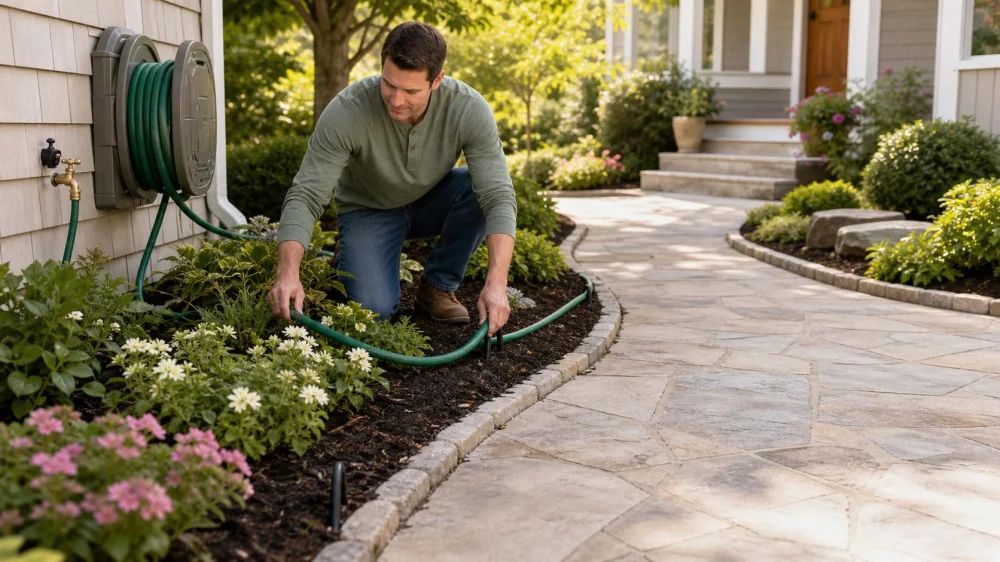
Route a garden hose along the edge of beds or hardscape, not across stairs, doorways, sidewalks, driveways, play areas, or mower paths. Use smooth guides at bed corners so the hose does not crush stems, strip bark, drag through mulch, or catch on lighting and irrigation parts. Choose only the length needed and store it fully after use.
Inspect the spigot, backflow device, connectors, washers, hose jacket, nozzle, reel, and guides for leaks or damage. Do not modify drinking-water protection, bury a standard garden hose as permanent plumbing, or run it near electrical hazards. Ask a licensed professional when a distant zone needs a permanent water point.
Map water points and destinations
Mark every outdoor faucet, approved quick-connect point, rain barrel outlet, hose reel, irrigation valve box, and regular watering destination. Include pots, new trees, vegetable beds, wash areas, and emergency reach needs.
Measure the practical route around buildings and beds rather than a straight line through them. Add only modest slack for handling. Excess length creates loops, pressure loss, storage bulk, and more places to kink or trip.
Note elevation changes, stairs, gates, narrow side yards, pets, children, vehicle routes, and where a door swings. A route that works in an empty yard may fail during a gathering or landscape service visit.

Keep hoses out of walking and driving paths
Never leave a hose stretched across a public sidewalk, accessibility route, front step, deck stair, threshold, pool edge, or nighttime path. If a temporary crossing is unavoidable during active use, keep the user present, make the crossing visible, and remove it immediately afterward.
Do not drive or park on a charged or empty hose. Tires can damage reinforcement and fittings, while a hidden hose can move unexpectedly. Keep routes away from garage doors, gates, and automatic equipment.
Landscape lighting reduces but does not eliminate the trip risk. Storage—not visibility—is the main control when watering ends.
Guide hoses around beds and plants
Place rounded hose guides at bed corners, tree rings, boulders, and other snag points. Guides should be stable, smooth, visible, and outside mower or foot traffic. Avoid sharp stakes that can injure people, pets, or the hose.
Keep the hose off tender stems, shallow-rooted new plants, tree trunks, and delicate bark. Pull from the direction of travel rather than yanking a loop from across the garden. Move slowly when a hose disappears behind shrubs.
Do not drag fittings through soil, ponds, pet waste, fertilizer, pesticide residues, or standing water. Keep the nozzle from resting in a container where contaminated water could contact it.
Choose hose length and hardware
Select a hose rated for its intended use, climate, water pressure, and any potable-water application. Diameter and length affect flow. Very long small-diameter hoses may deliver less useful pressure at the far end.
Use compatible lead-free fittings when required, sound washers, and a nozzle that shuts off reliably. A swivel or angled connector can reduce strain at a wall faucet, but it must not interfere with the required backflow device.
Mount reels and hangers into suitable structure at a reachable height. A fully loaded reel is heavy. Freestanding carts should remain stable when the hose is pulled sideways.
Store, drain, and inspect the hose
Turn off the water, release pressure safely, disconnect when appropriate, and drain the hose according to the manufacturer's instructions. Coil in broad loops or wind evenly on a reel without twisting.
Inspect for bulges, cracks, abrasion, soft spots, crushed sections, leaking couplings, corrosion, and a nozzle that will not close. Replace damaged pressure-bearing parts rather than wrapping a failing hose with ordinary tape.
Protect the hose from freezing, prolonged sun, vehicle traffic, rodents, and sharp tools. Follow local winterization guidance for outdoor faucets and irrigation equipment.
Know when to add another water point
A permanent solution may be better when the regular route crosses access paths, requires several connected hoses, cannot reach with useful flow, or creates repeated plant and property damage.
Ask a licensed plumber or qualified irrigation professional about code, permits, backflow prevention, freeze protection, pipe material, pressure, drainage, and location. Call the utility-marking service before excavation and do not assume an old landscape plan shows every buried line.
Drip irrigation or a properly designed watering zone can reduce manual hose travel, but it still needs compatible plants, pressure regulation, filtration, maintenance, and seasonal scheduling.
Frequently asked questions
Can I leave a hose across the lawn?
Remove it after use. A hose can interfere with mowing, become a trip hazard, hide in grass, damage turf, and deteriorate in weather.
Should I buy the longest hose available?
No. Buy enough for the safe measured route with modest slack. Extra length adds handling and storage problems.
Can I bury a garden hose?
Do not treat an ordinary hose as permanent buried plumbing. Use a designed, code-compliant system installed for the conditions.
Why does my hose kink at the spigot?
The route, connector angle, hose construction, reel location, or pulling direction may be causing strain. Reposition compatible hardware rather than forcing it.
Can one hose be used for plants and drinking water?
Only use a hose and fittings rated for potable water and protect them from contamination. An ordinary garden hose may not be suitable.
Safety and system limits
Keep water equipment away from damaged cords, outlets, power tools, and overhead or underground electrical hazards. Do not spray toward electrical systems, people, animals, traffic, open windows, or neighboring property.
This guide does not replace plumbing code, irrigation design, backflow requirements, drought restrictions, manufacturer instructions, or accessibility standards. Hire qualified help for permanent piping, backflow devices, electrical conflicts, high pressure, major leaks, unsafe excavation, or difficult access.
Next steps
Walk from the faucet to each watering zone with a measuring wheel or tape, sketch the safe edge route, and mark every snag and crossing. Add rounded guides, remove excess hose, test flow, and photograph the stored condition. If the safe route remains impractical, get a quote for a permanent water point or designed irrigation zone.
 Envision Outdoor Services5.0 (25 reviews)
 HR Landscape Services5.0 (6 reviews)
 D K Landscape & Design3.0 (9 reviews)
 Nate's Lawncare LLC5.0 (3 reviews)
 Rose Hill Landscaping4.0 (102 reviews)
 Wawasee Professional Property3.0 (2 reviews)
 How to Choose & Place Outdoor Sculptures or Art in Your Landscape
 How to Build a Wildlife Habitat Garden That Supports Biodiversity
 How to Design a Garden That Changes All Year
 How to Incorporate Seasonal Lighting Into Your Landscape Design
 Plan Landscape Spacing With Mature Plant Size
 How to Create a Courtyard Garden With Limited Space