
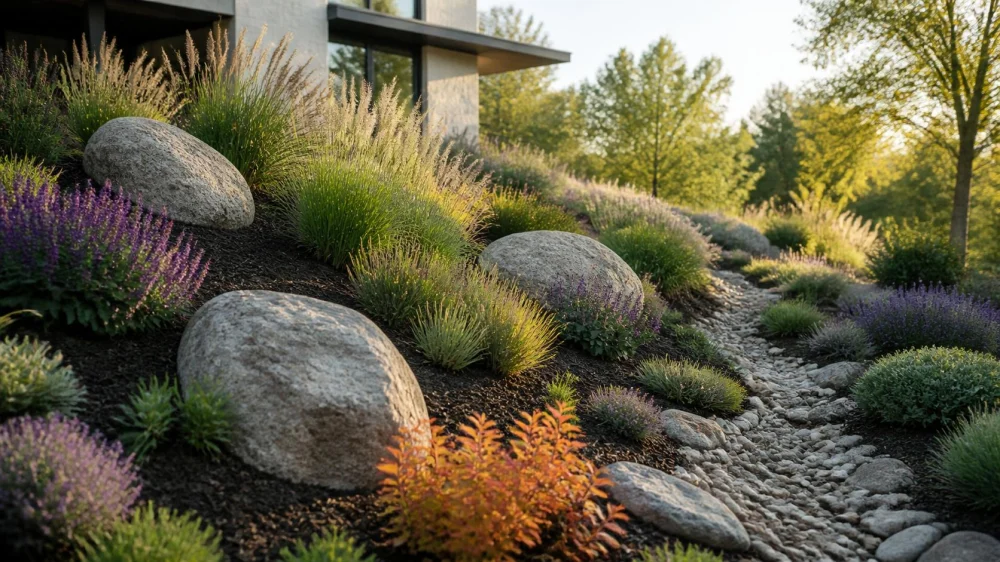
Landscape Boulder Placement: Plan Scale, Stability, and Drainage
On this page
Quick answer
Treat landscape boulders as structural site elements, not portable decorations. Choose size and stone type after measuring access, slopes, utilities, drainage, sightlines, and mature plant space. Require a stable prepared base, controlled machine path, and a placement sketch that shows how much stone will be buried. Keep boulders clear of foundations, drains, gates, play areas, and vehicle visibility, then inspect for rocking and erosion after storms.

Why it matters
Large stones are extremely heavy and can roll, settle, redirect runoff, damage buried lines, or block maintenance. Scale and orientation also determine whether the result looks integrated or dropped in place.
This United States landscaping guide is general. Soil, frost, seismic conditions, slope, drainage, utilities, access, permits, and stone weight vary. Engineered slopes and retaining functions need qualified design.
Clausen Landscape & Design
2N967 Francis Road, Maple Park, IL 60151, USA
Practical checklist
- Measure the intended footprint, visible height, clearances, and viewing angles.
- Locate utilities and irrigation before digging or machine travel.
- Map runoff, drains, foundations, walls, trees, gates, and maintenance routes.
- Confirm stone dimensions, approximate weight, color, texture, and delivery orientation.
- Specify equipment access, ground protection, spotter, and exclusion zone.
- Define base preparation, burial depth, backfill, and erosion control.
- Approve final orientation before the lifting equipment leaves.
Step-by-step plan
- Mark candidate locations with cardboard or stakes and view them from doors, paths, street, and seating areas.
- Have utilities located and verify the proposed excavation and equipment route.
- Excavate a stable seat sized for the actual boulder and site conditions.
- Place and rotate the stone with rated equipment under one designated signal person.
- Embed enough of the boulder to create a natural, stable appearance without guessing at structural support.
- Restore drainage, compact suitable backfill in controlled layers, and keep soil away from siding and trunks.
- Photograph placement and recheck movement, ponding, and erosion after watering and major rain.
Save plan dimensions, utility markings, stone source and size, equipment path, base details, placement photos, drainage observations, change approvals, and post-storm inspections.
Limits and warning signs
A boulder is not automatically a retaining wall, traffic barrier, seat, or climbing feature. Surface wedges and loose mulch do not correct an unstable base or active slope movement.
Stop work if utilities are uncertain, equipment loses stable footing, the stone rocks, soil slumps, or drainage is redirected toward structures. Use an engineer or qualified contractor for retaining, steep-slope, overhead, or vehicle-impact applications.
Frequently asked questions
How much of a boulder should be buried?
There is no universal percentage; base conditions, shape, slope, and design intent control.
Can a boulder hold back soil?
Only when the system is designed for that load; a decorative stone should not be assumed to retain a slope.
Should stones match exactly?
Related color and geology often look cohesive, while varied size and orientation avoid repetition.
When should placement be inspected?
Before equipment leaves and again after irrigation, settling, freeze-thaw, or major storms.
Sources and evidence
The guide applies excavation safety, utility-location, lifting, slope-stability, and drainage principles: measure the real stone, prepare a stable seat, control equipment access, protect utilities, and verify runoff and settlement.
Conclusion and next steps
Mock up the size, locate utilities, map drainage, and approve equipment access. Place the actual stone on a prepared seat with a controlled lift, then document and inspect it after water and weather.


 Evergreen Lawn Care4.0 (35 reviews)
 Don Fiore Co Inc5.0 (1 reviews)
 Blue Ridge, Inc4.0 (14 reviews)
 The BackyarDream Landscaping5.0 (39 reviews)
 Grams Lawn Service LLC5.0 (30 reviews)
 Bernat Landscaping4.0 (14 reviews)
 How to Landscape Using Recycled or Reclaimed Materials | Beautiful Landscapes
 How to Use Vertical Gardening to Max Out Small Yards
 How to Use Stepping Stones to Guide Garden Movement
 How to Choose Outdoor Furniture That Complements Landscape
 How to Incorporate Ornamental Trees Into Small Landscapes: A Beginner’s Guide
 How to Use Container Planting in Small Spaces for a Beautiful Garden